



Imagine a person searching for speech therapists, and your practice did not pop up, not even on the second page? This means that you are doing something wrong. With the global speech therapy market size expected to reach USD 63.8 billion by 2030, standing out will offer a great opportunity for speech therapy practices. But is it even possible in this highly crowded market? Well, it is through effective SEO for speech therapists.
By implementing effective search engine optimization strategies, speech therapists can enhance their visibility in organic searches, drive high-quality traffic, boost credibility, and enhance user experience.
If you are a budding speech therapist who is looking to enhance your search engine rankings, then this blog is for you. It will discuss what SEO is, the importance of SEO, effective SEO strategies, major SEO challenges, and more for speech therapy practices. So, let’s get started.
What is SEO for Speech Therapists and How Does it Work
SEO for speech therapy practices is the strategy implemented by speech therapists to optimize their online presence to rank higher on Google for searches like “speech therapists near me.” The main goal of speech therapist SEO is to make your practice appear in front of your audiences for relevant searches.
Search engine optimization consists of various approaches, but all of them have one sole goal: to satisfy Google’s ranking algorithms to make your website content appear in a prominent position in the search results.
This digital marketing strategy works by pleasing Google’s algorithm through the development of high-quality content and a technical setup, leading to increased online visibility and helping speech therapists successfully connect with patients when they are looking for speech therapy services.
Why Must a Speech Therapist Invest in SEO
You now know what SEO for speech therapists is and how it works, so let us move on to why your speech therapy practice needs SEO and why you must invest in it.
- Help Generate a Good Number of Traffic
Ranking higher in the search engines will automatically get you more clicks; this is not rocket science, right? And more clicks means more website traffic. According to a study by Backlinko, the top 3 Google search results get 54% of all clicks. It means the first 3 search results are getting more than half of the clicks.
Search engine optimization guarantees that your practice appears prominently when patients search online for services like “pediatric speech therapist near me” or “adult speech therapy solutions.
- It is Highly Cost-Effective
Unlike PPC ads, where you have to pay a fee every time someone clicks on your ad, the traffic generated by SEO is completely organic and free on a per-click basis.
Although there is an initial investment in creating quality content and effectively optimizing your website, the ongoing ROI is outstanding as the visibility persists for a long time after the initial tasks are done, offering constant lead generation at an affordable budget.
- Provides Measurable Results
SEO outcomes are quantifiable, which means speech therapy businesses can easily measure the effectiveness of their SEO campaign. You can easily determine key metrics such as traffic, organic rankings, and conversions.
Getting valuable insights on these metrics can help you refine your strategy and invest in resources that work best.
- Offers a Better User Experience
Advanced SEO efforts are deeply associated with good web design and user experience. Search engines like Google prioritize websites with mobile-friendly structures, fast loading speeds, and easy navigation.
By investing in effective SEO for speech therapists, they can naturally enhance their website for visitors, making it easier for prospective patients to navigate between pages, quickly find the information they are looking for, and take the next step.
Effective SEO Strategies for Speech Therapists that can Help Enhance Online Visibility
To ace your search engine optimization game, you need effective SEO tactics. This section of the blog will discuss some of the best SEO strategies that speech therapy practices can incorporate to improve their online visibility.
- Start by Researching and Implementing the Right Keywords

The prime step to doing proper SEO for your business is thorough keyword research. This is one of the most crucial yet challenging parts of your SEO strategy.
However, to make the process a little easier for you, we have come up with a quick guide on how speech pathologists can perform keyword research. But before that, let us look at why keyword research is vital for your practice.
Importance of Thorough Keyword Research
Here are some major reasons why keyword research matters in SEO.
- Understanding your Audience: Keyword research unveils the exact search terms and language your target audiences are using when looking for speech therapy services. This data allows you to develop content that aligns with their needs and search intent.
- Driving Targeted Traffic: By targeting relevant keywords, speech therapists can attract users who are genuinely interested in receiving speech therapy treatments. This leads to high-quality traffic that is more likely to convert into loyal patients.
- Informing Content Strategy: Keyword data allows patients to identify gaps in your current content, helps you discover new topics, and prioritize content creation efforts on the basis of search volume and user demand.
- Enhancing Visibility in Search Engine Results: Proper implementation of keywords can help search engines to easily understand what your content is about, leading to higher rankings in the search engine result pages and better visibility.
- Gaining a Competitive Edge: By analyzing the keywords your competitors are using and ranking for, speech therapists can identify “keyword gaps” that can help them find unexplored opportunities and shape a unique presence in the market.
How to Find Relevant Keywords for your Speech Therapy Practice
Now that you know the importance of thorough keyword research, let us discuss how speech therapists can find relevant keywords for their practice.
- Understand your Target Audience
Before you even start researching keywords, it is crucial to understand who your ideal audience is. What are their needs and concerns? And what are their goals?
In order to get insights, speech therapists can explore patient queries on online forums (Quora, Reddit), social media discussions, and Google’s “People Also Ask” or Google’s Autocomplete.
Knowing your target audience will help you easily identify relevant keywords that you can use in your marketing efforts.
- Brainstorm Relevant Topics for Keyword Research
When you have a clear idea of who your target audiences are, their needs and preferences, you now need to brainstorm topics that are closely related to your speech therapy practice.
For example, if you specialize in adult speech therapy, your seed keywords might be,
“Speech Therapy”, “SLP for adults”, “Adult Speech Therapy”
To find seed keywords for effective SEO for speech therapists, they must,
- Think about the main topics that are relevant to their practice
- Use Google Autocomplete. Start typing a keyword on Google and see the suggestions it gives
- Evaluate competitor websites thoroughly to determine which search terms they are using frequently.
These topics will help speech pathologists effectively guide their keyword research.
- Implement Advanced Keyword Research Tools
Keyword research is quite a job if you do the whole thing manually. To make the job easier, speech therapists can implement modern keyword research tools that are being widely used by the majority of businesses nowadays.
- Google Keyword Planner
First in the list is Google Keyword Planner. It is a free and most preferred keyword research tool among businesses and marketers. It is actually a feature of Google Ads, but it can be used for SEO keyword research as well.
By implementing this keyword research tool, speech pathologists can explore new keywords, gain search volume, and forecast various keywords. It also helps users to take up a bunch of keywords and get their search volumes, so that they can determine which keywords have the most search volume and competition level.
The best part of using Google Keyword Planner for keyword research is that it extracts and leverages data from Google, so oftentimes, the data is accurate. Speech pathologists can use it to explore long tail keywords on the basis of a seed keyword.
- Ahrefs
This is another popular keyword research tool that is used by thousands of SEO professionals and agencies. Ahrefs is more than just a tool for exploring search queries. Speech therapists can use this tool to search for relevant SEO keywords for their practice, explore new keyword ideas, conduct thorough competitor analysis, and perform advanced organic searches.
What makes Ahrefs stand out from other tools is that it allows advanced SERP analysis. Ahrefs offers a comprehensive SERP overview, in which it shows top-ranking pages along with their authority and major SERP features such as “People Also Ask” queries.
- SEMrush
SEMrush is quite similar to Ahrefs and allows speech pathologists to do all the standard keyword research stuff, as well as analyze your competitors. The Keyword Magic Tool of SEMrush can help generate millions of keyword ideas, group them by topics, and offer metrics like keyword density, search volume, and intent from a vast database.
This tool can also provide useful data on the keyword gap and classify keywords (information, transactional, and navigational) to help speech therapists develop content that aligns with user goals.
- Determine Search Intent
Remember, not every keyword serves the same purpose. Some users are simply looking for information, while others are ready to take up a service. It is crucial to understand that researching keywords means aligning them with the right search intent. Considering user search intent is vital for successful SEO for speech therapists. So let’s look into the major types of search intent.
- Informational: “Signs of autism in toddlers,” “how to treat dysphagia at home,” “What is apraxia in adults.”
- Navigational: “Dr Sarah’s Clear Voice Clinic location,” “Happy Talk Clinic reviews,” “Little Voices Clinic contact information.”
- Commercial: “best pediatric speech therapy in Boston,” “Speech therapy for aphasia cost,” “Speech therapist near me.”‘
- Transactional: “Book speech therapy consultation,” “Speech therapists accepting new patients,” “Sign up for a speech pathology evaluation.”
Before targeting a specific keyword, speech therapists must always make sure to check the top-ranking pages on Google. If the majority of them are blog articles, then the intent is informational. In case they are product pages, they are likely to be transactional.
- Assess Competitor Keywords
Effective competitor analysis can help speech pathologists to find opportunities that have not been discovered yet by their competitors. For conducting keyword research, you can leverage tools like Ahrefs, Moz, or SEMrush.
Here are some of the crucial things you need to notice when doing competitor analysis,
- See what keywords your competitors are ranking for
- Determine high-traffic keywords that you may have missed
- Find keyword gap areas where competitors are ranking, but you are not.
By carefully analyzing competitor strategies, speech pathologists can modify their keyword selection process and target search terms with a lower competition level.
- Group and Organize Keywords
Having a long list of keywords can confuse you if you do not organize them into relevant clusters. Organizing your content neatly can help with content planning and prevent keyword overlap.
- Primary Keywords: These are the main focus of the content (e.g., “how to find a speech pathologist for stuttering”)
- Secondary Keywords: Related search terms that can support the primary keyword (e.g., “how to find your speech therapy goals”)
- LSI Keywords: These are contextual words that naturally fit into content (e.g., “stuttering treatment”, “speech fluency”).
Grouping keywords makes sure that content remains structured and covers a broad range of closely related terms.
- Focus on Keywords Based on Opportunity
Not every keyword is worth targeting. So, speech therapists must prioritize search terms based on:
- Search Volume: How many people are searching for a specific keyword monthly?
- Keyword Difficulty (KD): How competitive is the keyword?
- Relevance to your Practice: Does it perfectly align with your content goal?
- Conversion Potential: Will the specific keyword attract the right audience?
A well-balanced keyword strategy often includes a blend of low-competition and high-traffic terms to boost rankings and online visibility.
- Master your Local SEO Strategy
This is a vital aspect of SEO for speech therapists that focuses on optimizing their website in local search queries. Local search engine optimization is especially important for speech therapists who have a physical location. This SEO strategy helps speech therapists to rank their business more often on local search results for keywords that include “near me” searches. (e.g., the best speech therapy clinic near me).
By optimizing your website for local search queries, you can boost the chances of getting noticed by more local audiences who are based in the proximity of your clinic.
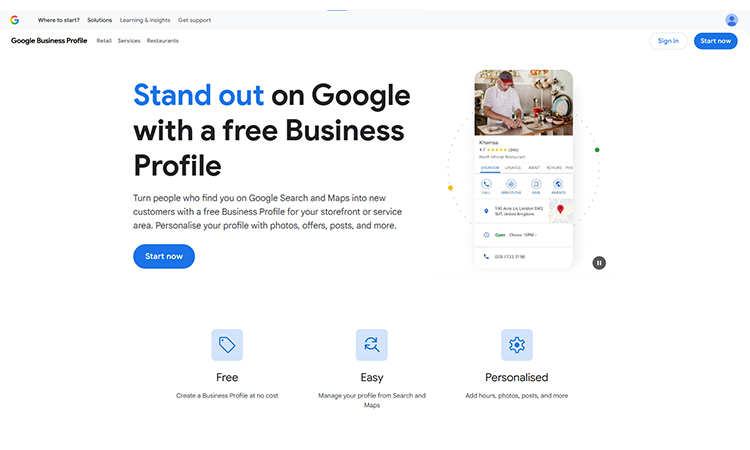
Local SEO strategies include creating, claiming, and verifying your Google Business Profile, adding pictures of the locality of your clinics, and adding your address in the footer of your website.
Here are a few ways how speech therapy businesses can do proper local SEO for their practice.
- Google Business Profile
Google Business Profile, formerly known as Google My Business, is a vital element for local businesses. To create the Google Business Profile of your practice, you need to follow some quick steps.
Claim your Business Profile
The first step to optimizing your GBP is to claim it. This includes verifying your business information with Google.
Search for your Business:
- Start by searching for your business on Google using your device.
- Now type your practice’s name in the search bar.
Find your Profile
- Select your business from the search results.
- Now, look for an option like “Claim this business,” then “Own this business?” or “Manage now” below the business details or on the profile itself.
Initiate Claim Process
- Click on “Claim the business” or “Manage now.”
- Confirm you own or manage this business.
Choose a Verification Method
Google offers multiple verification options to prove that you are the owner, such as;
- Postcard: Google will email a code to your business address
- Video: Record a video showing your speech therapy clinic and proof of your ownership
- Phone/Email: Receive a code through call or email (if set up).
Complete Verification
- Finally, speech therapists need to select their preferred method and follow the steps given on screen to enter the code and complete the verification process.
- Fill Out your Profile Details
Once you have claimed your Google Business Profile, you need to fill in all your necessary business details. Ensure that you fill out all the relevant sections to create a complete GBP profile.
Include relevant details such as address, name, website URL, services you offer, and hours of operation. Speech therapy practices can also add brief descriptions about their practice and the types of conditions they treat.
You can also note special features of your business, like “woman-owned,” “wheelchair accessible.” The more you fill out your Google Business Profile, the better, as it will offer more information about your business to your audiences.
- Add Real Photos
In order to establish business authority and foster trust among potential patients, speech therapy practices must add several photos of their practice location, procedures, and products. Adding photos to your Google Business Profile is crucial for effective SEO for speech therapists. Upload some professional headshots as well as pictures that capture your work environment and the type of services you offer.
- Keep your Business Information Updated and Accurate
Speech therapy practices must make sure that their business information is up-to-date and accurate. This includes your business name, phone number, address, and hours of operation. Maintaining NAP consistency (Name, Address, Phone number) across all patient touchpoints is vital for ranking higher in the local search.
- Implement Local Keywords
To target local clients, use location-specific keywords in your GBP business description. Speech therapists must include the name of their city or region in their keyword research to enhance their chances of ranking higher for location-based searches. Incorporating relevant local keywords, such as “best speech therapist near me” or “speech therapy services in Canada,” can enhance your local search engine rankings.
- Create Local Content
Speech therapists must develop local content such as blog posts, articles, and guides that are relevant to their local community. This will help them get featured on local news sites, articles, and sponsor local events to gain valuable backlinks.
Steps on how speech therapists can create local content:
- Keyword Research: Identify location-specific keywords for your potential patients to use, such as “pediatric speech therapy in Manhattan” or “best stuttering treatment near me.”
- Focus on Local Issues: Develop content that directly addresses common speech challenges specific to your area.
- Blog Posts or Articles: Speech therapists must write educational articles addressing common speech challenges that align with the local community. For example, speech therapists can create a blog post titled, “Navigate Speech Challenges with [Your Practice Name], Your Trusted Local Speech Therapist.”
- Share Success Stories: With patient consent, speech therapists must share narratives of local individuals who have gained successful results from their treatments. This fosters trust among potential patients.
- Location References: Make sure to incorporate local keywords organically in your page titles, headers (H1, H2), image alt tags, and meta descriptions.
- Create an FAQ Section: Speech therapists must address common queries about the insurance, therapy process, or local resources on your website. This section can be a valuable resource for your potential clients.
- Host Local Events: Offer free or low-cost screenings or workshops at community centers or schools to showcase expertise and connect directly with prospective patients.
- Establish Trust with Online Reviews
In the world of SEO, reviews are like gold mines. They not only help foster trust among prospective patients but also establish brand authority. Speech therapists must encourage their satisfied clients to leave reviews about their experience on platforms like Google Business Profile.
Make sure to always respond to these reviews professionally, as it will showcase that you value their feedback and are committed to offering the best speech therapy.
Here is how speech therapists can establish trust with online reviews
Encourage Real Reviews:
- Ask at the right time: Speech therapists must keep it simple and ask happy customers for reviews at major positive moments in their journey.
- Leverage Trusted Platforms: You must encourage reviews on reputable websites, like Yelp, Lybrate, and Trustpilot, where users will trust the feedback.
- Offer Direct Links: Make the review-giving process seamless with direct links in emails or on your site.
Display your Reviews Strategically
- Be Transparent: Transparency is crucial for effective SEO for speech therapists. Showcase both negative and positive reviews to prove that you are not hiding anything and are completely transparent with your patients. This will foster trust among potential patients.
- Add Details: Speech therapists need to include their reviewer’s details, such as name and location, to highlight authenticity and add context.
- Update Regularly: Make sure to keep your reviews up-to-date and fresh in order to show ongoing patient satisfaction.
- Show your Success: Leverage detailed testimonials and case studies to show the benefits and solutions of your speech therapy.
Respond to Reviews Promptly and Professionally
- Be Quick yet Professional: Timely and polite responses show that you care about your patients and are committed to offering the best.
- Provide Solutions: Offer a clear solution to patients who have had a negative experience with your speech therapy practice. It is best to take the conversation offline for complex issues.
- Acknowledge and Apologize: Rather than justifying mistakes that happened from your end, acknowledge and even apologize if necessary. Speech therapists must always validate their patients’ feelings, even if they disagree with the whole review.
- Show Courtesy: Be courteous and thank every patient who leaves a review. No matter positive, negative, or neutral, you must reply with a short thank you message. This will fortify positive aspects of their review.
- Develop High-Quality, Valuable Content
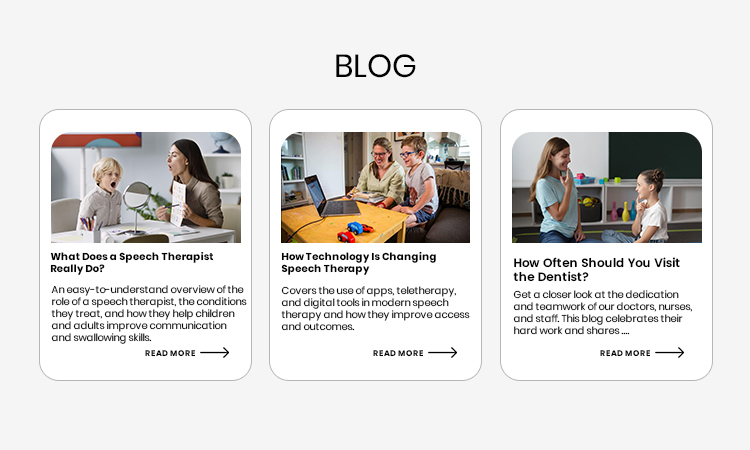
It’s 2025, and content remains the king.” Developing high-quality content is the key to successful SEO. By creating content that is not only authentic, valuable, and appealing to patients, speech therapists can make their patients stay longer on their website, ultimately leading to lower bounce rates.
Consider content as the concrete of a house- without high-quality concrete, the house won’t stand. Similarly, without high-quality content, your SEO efforts will go in vain. So, this section of the blog will discuss how speech therapists can create exceptional content for SEO.
But before that, we will discuss the type of content speech therapists can develop. So let’s get into it.
- Comprehensive Guides for Parents/ Caregivers: Speech therapists can develop content that addresses the common queries, like “signs your toddler needs speech therapy,” “how to help a child with a lisp,” and “navigating the major challenges of the IEP process.”
- In-depth Articles on Treatment Techniques: Create articles clearly conveying valuable information on specific methodologies like language interventions or oral motor therapy techniques, when they are effective, and who should seek them.
- Tips and Exercises: When developing content for your speech therapy practice, you must make sure to share practical tips for managing speech challenges at home or in daily life.
- Develop Localized Content: Speech therapy practices must develop posts that clearly cover local events, specific community activities, or resources to target local audiences.
- Images and Photos: Speech therapy practices must use high-quality photos and images of their clinic space, team of experts, and staff, and the local area around their clinic to establish an authentic and trusted brand image.
- Videos: Developing short videos discussing the common speech topics, showing exercises, or introducing the team can help enhance engagement and prominently feature your practice in the search results.
- Infographics: Speech therapy practices can also create visually appealing summaries of complicated information, such as the stages of speech development or a brief comparison of types of speech therapy.
- Client Success Stories: With prior permission from patients and adherence to privacy regulations like HIPAA (Health Insurance Portability and Accountability Act), sharing general and experience-led success stories can help speech therapists make patients feel confident about their decision and foster trust.
- Testimonials or Reviews: This type of content is vital for SEO for speech therapists. Speech therapy practices must actively encourage happy patients to leave their valuable reviews on your Google Business Profile and other third-party directories. This user-generated content is an exceptional SEO signal.
- How-Tos: Make sure to write comprehensive, long-form content of around 800- 1000+ words, like guides to overcome stuttering challenges or busting common myths on speech therapy.
- Articles Addressing Common Concerns: Speech therapy businesses can develop in-depth content or articles that answer specific queries of patients surrounding speech therapy. Consider queries like “How do I know my child needs speech therapy?” “Tips for managing stuttering in a school setting,” or “What is the average cost of speech therapy?”
Now that we have a clear idea of the type of content speech therapists can develop, it’s time we focus on how you can create SEO-friendly content for your practice.
- Understand User Intent
Even before you start developing content, speech therapy practices must determine why users are searching for a specific topic (informational, navigational, commercial, and transactional intent). Speech therapists must make sure to create content in a way that satisfies patients’ search intent.
In case you don’t know what search intent is, search intent is the reason why users search for your keywords. There are four major types of search intent. Let’s take a quick look at them.
- Informational Keywords: The searcher is simply looking for information about a particular speech therapy treatment.
- Navigational Keywords: The searcher is looking for a specific page or website of a particular speech therapist or speech therapy clinic.
- Commercial: This search intent denotes that the searcher is researching options.
- Transactional Keywords: The searcher is ready to make a purchase or is willing to take up a speech therapy treatment soon.
For blog posts, speech therapy services must make sure their primary and secondary keywords have informational intent. This is because users who wish to learn something about a particular speech therapy topic find the in-depth articles and blog posts helpful.
- Establish Topic Authority (E-E-A-T)
One of the most important ranking factors for SEO for speech therapists is EEAT-friendly content. Remember, Google values authoritative content more than anything. Google leverages a framework to assess content quality for search rankings, prioritizing in-depth knowledge (Expertise), first-hand skills (Experience), robust reputation (Authoritativeness), and overall reliability (Trustworthiness) to show helpful, valuable, and rich results to its audience.
As the EEAT framework helps Google to identify high-quality and people-first content, developing content by following the EEAT framework can help speech therapy practices rank higher in the search results. EEAT is especially crucial for “Your Money, Your Life” topics, where incorrect information can be damaging.
Speech therapy practices can:
- Demonstrate Experience: By sharing case studies (with client permission), valuable insights, and original photos/videos.
- Showcase Expertise: By going deep with crucial topics and citing authoritative sources (medical journals, studies done by experts, news articles).
- Establish Trust: Speech therapists can build trust with clear information, a secure website (HTTPS), and professional author bios.
- Structure your Content with Relevant Subheadings
Subheadings (H2, H3, H4…) are miniature titles that divide your content into clear sections, making the vital areas more easily readable for speech therapy seekers.
They are crucial for SEO as they help speech therapy practices:
- Make their content easier to read and understand
- Leverage keywords and relevant search terms organically
- Allow patients to easily find the information they are looking for.
Speech therapists must structure their content similarly. First, they need to develop an engaging title that includes your primary keyword. This will be your H1, which is the first heading of your content.
Then, speech therapists need to organize the rest of their content with relevant H2, H3 subheadings, and so on. By clearly organizing your content with subheadings, speech therapists can develop a clear and logical structure that can help both Google and readers understand and easily navigate your content.
- Develop Easily Readable Content
One of the most crucial aspects of effective SEO for speech therapists is readability. It is a measure of how easily your audience can read and understand your content.
If your content is very hard to read, it is likely to increase bounce rates and never come back again. Bounce rates signal search engines like Google that their content is of low quality and might not rank well.
Leveraging subheadings is a good way to start. However, there are multiple other things you need to do in order to enhance readability.
- Incorporating short sentences and paragraphs can help speech therapy practices make your content more comprehensible and easily readable.
- Using simple and clear language can help readers of every level to understand your content.
- Speech therapists must implement visuals such as images, graphs, and other assets that can enhance their content and make it more interactive.
- Using bullet points and numbered lists can be great for conveying information in a very clear and concise way.
In case you are just starting and have no idea of the technicalities of content marketing, you can perhaps seek professional content marketing services.
- On-Page SEO Strategy for Speech Therapists
On-Page SEO refers to the optimization of content on your website. On-page optimization is a crucial aspect of SEO for speech therapists, as it heavily contributes to enhancing search engine rankings.
This SEO approach encompasses optimizing your website’s meta titles, descriptions, content, image alt tags, and URLs. By implementing relevant keywords in the content, speech therapy clinics can improve their website’s relevance for certain search queries.
Here are some really crucial tips to optimize the on-page elements of your speech therapy website.
- Meta Tags
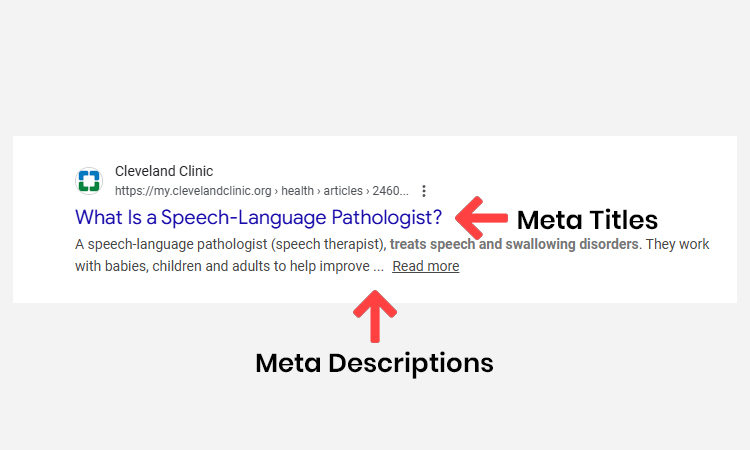
Meta tags consist of meta titles and descriptions that appear on search results when you search for something. Meta titles and descriptions are crucial as they briefly educate people on the topic of a particular content and also offer a summarized version of what readers can expect in a particular content. Optimizing these tags with relevant keywords will enhance search engine rankings.
Here is a quick guide on how speech therapists can use header tags.
- H1: Speech therapists must use the H1 tag on every webpage to clearly convey the main topic of the page or content. Make sure to implement your primary keyword in H1.
- H2: Break down large chunks of paragraphs into small sections on a page. Use engaging and informative subheadings (H2s) to make your content easily readable.
- H3: H3 tags can be incorporated in other subsections later in the content within each H2 section.
- Schema Markup
Speech therapy practices must not forget to add schema markup to various webpages on their website. They can add schema to service pages, articles/blogs, or products. Adding schema markup can help search bots to easily understand your content and then optimize it to improve your SEO rankings.
- Image Alt Tags
Alt tag optimization is often overlooked by a lot of businesses and marketers, but it plays a major role in SEO. These texts briefly describe any image that you have used on your webpage. When optimizing the alt tags of your website images, speech therapy practices must not forget to add their target or primary keyword in it, if it fits naturally.
- Website URLs
The URL of a webpage must clearly showcase what the page content is about. For instance, if a particular web page contains content on articulation drills, about the treatment, and its benefits, then the URL slug must be something like, “https.//Dr.WhitmoresSpeechTherapyClinic.com/articulationdrills/”
- External and Internal Linking
The links of your website’s inner pages must also include relevant keywords. This will guide visitors to a page where they can easily access the information they are looking for. Furthermore, audiology practices can carefully integrate their target keywords into external reputable speech therapy websites or other related medical fields within the specific niche.
Internal links are valuable assets for SEO content. These are hyperlinks that connect one page to another page within the same domain or website to direct readers to other valuable and relevant content.
Both external and internal links are vital for SEO as they distribute link equity. When adding links, speech therapists must make sure their anchor texts are relevant to the linked content. So, they must avoid adding links anywhere and everywhere, and instead incorporate links only where they fit naturally.
For example, if you are writing an article about oral motor therapy, you can add links to other relevant pieces of content that offer more information on topics such as:
- Motor speech disorders
- Speech development therapies for adults
- Best oral motor exercises for children
These links can help readers learn more about oral motor therapy and show Google that your website is an authoritative source on that particular topic.
- Link your Content to Highly-Authoritative External Sources
Including external links to relevant and authoritative websites for sourcing purposes showcases that your content was created keeping precision and authenticity in mind.
External links can be very valuable to users. This is because these links can guide users to resources that can enhance their knowledge of the topic.
It is a great idea to provide external links anytime you are referencing:
- Surveys
- Statistics
- Interviews
- Case studies
- Reports
However, statistics and research do change with time. So, speech therapists must make sure they link their content to the most up-to-date information available.
- Optimize Meta Title and Description
Search engines like Google consider meta tags to determine what your content is about. This is crucial so that Google can rank your content appropriately.
Title tags and meta descriptions are the first impression of your speech therapy practice, as they are the first thing your audience will come across when your website or content appears in the search results.
So, it is worth optimizing them. So, let’s see how you can optimize them.
Meta Title Optimization
- Length: Optimizing meta titles is crucial for SEO for speech therapists. They must make sure to keep their meta title between approximately 50 and 60 characters to avoid truncation in the search engine results.
- Implement your Target Keyword: Position your main keyword at the beginning of your meta titles, but organically. This will help you rank well for that keyword and show relevance to the user’s question.
- Keep it Appealing: Incorporate power words, brackets, and numbers to encourage users to click on it.
- Add your Business Name: Speech therapists can add their business name if space allows it; this adds value to your content.
Meta Description Optimization
- Keep them Short: Google often shortens meta descriptions that are too long, especially on smaller screens. So, speech therapy practices must make sure to keep their meta descriptions within 150-160 characters on mobile to ensure the best visibility.
- Use Active Voice: Voice therapy specialists must use the active voice when writing their meta descriptions to enhance clarity by addressing users directly.
- Incorporate Action Verbs: Using active verbs in meta titles can help encourage users to click through to your article and read it. So, speech therapy practices can incorporate phrases like “learn more” to make it more appealing.
- Use Target Keywords: Strategically weave your primary and secondary keywords organically. This will tell users that your page effectively covers the topic that they want to learn more about.
- Make it Benefit-Driven: Through your meta descriptions, you must tell your audience what they will gain or what problems will be solved by clicking.
Finding all of this a little too overwhelming? You can perhaps seek expert SEO services.
- Optimize your Website’s Technical Health
This is another crucial SEO aspect that heavily contributes to SEO. Now you must be wondering, how? See, imagine you are searching for something urgent, and you land on a website that is taking forever to load, annoying, right? In this case, you will probably exit the website and search for the information on other websites. This is exactly how visitors feel when they land on a slow-loading website.
If your website’s technical health is good, high chances are you will secure a good position in the search results. So, here are some technical components speech therapists must consider to edge the ranking game.
- Website Speed
Website speed plays a significant role in SEO for speech therapists. Do you know that? A website that loads in just 1 second has a 2.5x times higher conversion rate than websites that load in 5 seconds. This statistic shows the importance of a fast-loading site.
By using browser caching, compressing images, minifying CSS and JavaScript, speech therapists can enhance their website loading time.
- Focus on Easy Crawlability and Indexability
Google and other search engines use bots, also known as crawlers, to easily explore and navigate sites. Through effective technical SEO, speech therapy practices can make sure these bots can seamlessly access all the vital pages of your website to determine what the website is about and rank it for relevant searches.
- Develop a Clean Site Structure
Developing a simple and organized website structure is crucial as it allows search engines to understand the relation between pages, ensuring that all the important pages are easily accessible from the homepage.
- Ensure Mobile-Friendliness
With the majority of website traffic coming from mobile devices (62.54%), Speech therapists must make sure that their website performs well on all types of screen sizes, especially smaller screens like mobiles.
Not only that, but Google also prioritizes mobile-friendly websites and ranks them higher in the search engine results.
- Implement HTTPS
Speech therapists must incorporate HTTPS, as it is a vital step towards ensuring a secure website. HTTPS guarantees that the data that is being transferred between the user’s browser and the website is properly encrypted.
Speech therapists can implement HTTPS by obtaining an SSL certificate. This not only secures the connection but also heavily contributes to enhancing search engine rankings as it is a major ranking factor.
- Effectively Optimize Robots.txt File
The robots.txt file serves as a guide for search engines to easily navigate a website’s content. Optimizing this file is a must, as it tells which parts of the website should be crawled and which ones to ignore.
It is recommended that speech therapy practices regularly review their robots.txt file to guarantee that search engines are not being accidentally blocked from crawling crucial pages.
- Develop and Update XML Sitemaps
XML sitemaps are basically roadmaps that help search engines explore the most important pages of a website. It is crucial to create and keep them up-to-date, especially after adding new pages or removing old ones on your speech therapy website.
A precise sitemap submitted to search engines facilitates the crawling process, making it easier to index website changes more effectively.
- Establish Authority with High-Quality Backlinks

Backlinks act as “votes of confidence” from other websites. These links tell search engines that your speech therapy practice is trustworthy and authoritative, enhancing rankings, driving targeted traffic, and helping discover content.
High-quality backlinks can help establish credibility, making your website significantly more visible and valuable in the SERPs. Here are a few ways in which speech therapy practices can gain high-quality backlinks.
- Guest Posting
Guest blogging is an exceptional way to improve link credibility. Speech therapy practices can politely reach out to reputable sources in the speech therapy industry and offer to write valuable guest blog posts. Guest posting is vital for effective SEO for speech therapists.
This will not only help speech therapists showcase their expertise but also help them achieve high-quality backlinks from reputable sources. As a speech therapy practice, you must make sure that your guest posts offer helpful information and insights to patients who are looking for speech therapy services.
- Digital PR
Digital PR is the implementation of online strategies that include influencer outreach, content creation, and social media to establish a brand’s online reputation, enhance online visibility, and enhance SEO by earning high-quality backlinks from authoritative websites.
Speech therapy practices must develop unique resources (e.g., comprehensive guides, interactive tools) that journalists and bloggers want to link to.
You can implement tools like Help Out a Reporter (HARO) to respond to journalist requests as an expert source, gaining links from major news websites. Speech therapy practices can also partner with niche-specific influencers for interviews, shared content, and guest posts to gain their backlinks and followers.
- Develop Linkable Assets
Speech therapy practices can develop linkable assets such as authoritative and unique content that resolves specific problems, answers crucial queries, and offers valuable insights that are not available elsewhere.
Linkable assets are resources that provide exceptional value and attract backlinks easily and organically. Different types of linkable assets encompass infographics, data-driven research, and comprehensive tutorials.
These assets do not gain backlinks randomly. Linked assets can prove to be valuable only when supported by a well-structured promotion strategy that includes in-person outreach to relevant bloggers and content writers, internally linking them to achieve initial authority and crawlability.
- Unlinked Mentions
Unlinked mentions are online references to your product, brand, or content that are mentioned on another website without a clickable hyperlink back to your website.
For example, a blogger writing about a specific speech therapy service/treatment you offer, but not including a clickable link to your website. While your business is mentioned, the absence of a backlink will make you miss out on the SEO benefits that come with it.
Reaching out to the author or editor and politely asking them to convert the unlinked mentions into a link is a great and ethical way to establish high-authority backlinks.
- Competitor Analysis
A competitor’s backlink analysis can help identify prospective link-building opportunities by revealing which websites are linking to your competitors and why. This process usually involves,
- Identify Top Competitors: Speech therapists must determine which sites are ranking higher for the same keywords you are targeting.
- Implement Backlink Analysis Tools: Tools such as Ahrefs, Moz, and SEMrush allow speech therapists to input competitor domains and view their complete backlink profiles.
- Determine Link Sources: Speech therapy practices must analyze the linking domains to understand the types of sites (e.g., blog articles, news, industry publications) that view your competitor’s content as authoritative.
- Identify Linking-Building Opportunities: Make sure to watch out for common link types, such as resource pages, guest posts, or mentions within the industry.
- Develop an Outreach Strategy: Speech therapy practices must develop valuable content that either aligns with or exceeds the quality of your competitor’s linkable assets and politely reach out to the same sources to earn a link to your website.
- Fixing Broken Links
Broken links can heavily impact SEO for speech therapists. These occur when a linked-to page has been deleted, is temporarily unavailable, or has been moved. These links often lead to a poor user experience and can negatively affect your SEO efforts by preventing the flow of “link equity” through your website.
To fix broken links:
- Crawl your Website: Speech therapists must incorporate a site audit tool (e.g., Screaming Frog) or Google Search Console to determine all internal and external broken links returning a 404 error code.
- Focus on Fixing: Make sure to emphasize internal broken links, as you have direct control over the destination pages.
- Incorporate Solutions:
- Internal Links: Speech therapists must update the link source to point to the accurate and working URL.
- External Links: In case the linked-to external content is gone, speech therapists must find a new and relevant source or completely remove the link.
- Implement 301 redirects: If you have moved a page to a new URL, you need to set up a permanent 301 redirect in order to guide both visitors and search engines to the right destination without any hassle.
- Design a Responsive Website
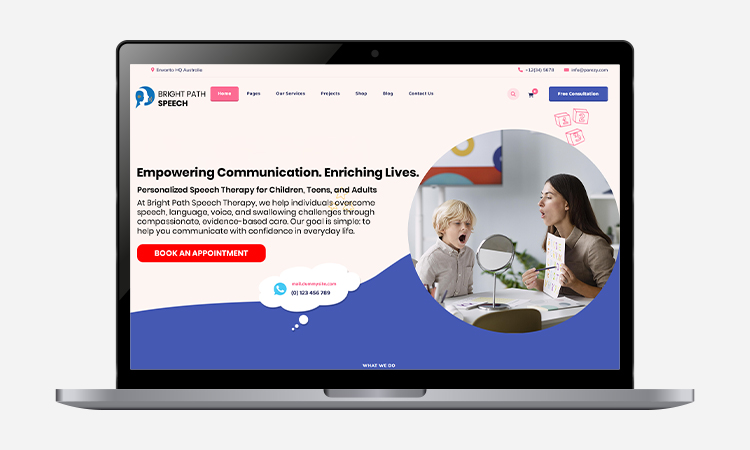
With the majority of web traffic coming from mobile devices. This means that if your website is not well-optimized for smaller screens, you are missing out on a significant amount of potential traffic.
Moreover, Google also prioritizes websites based on how responsive they are on smaller screens, so if your speech therapy website is not responsive enough on mobile devices, high chance your site won’t rank at all.
In order to avoid losing all the valuable traffic, speech therapy practices need to make sure they create a mobile-friendly website, which they can only do by implementing a responsive design.
How Can Website Design Contribute to SEO
Website design is one of the major pillars of SEO success. This is because it influences how search engines crawl your speech therapy website and how visitors interact with your website. Here are a few ways in which website design contributes to successful search engine optimization.
- Enhanced User Experience: A clear, intuitive design with a fast-loading time can make website visitors stay longer on your website (higher dwell time), leading to lower bounce rates, signaling Google that your speech therapy website offers value.
- Mobile-first Indexing: Mobile-first indexing is a must for successful SEO for speech therapists. Google fundamentally uses the mobile version of a website when indexing and ranking. A well-responsive design ensures that your website is mobile-friendly, which is a crucial ranking factor in today’s digital age.
- Faster Page Speed: A well-optimized design, including compressed images and clear code, often leads to faster loading times, which is a significant ranking signal for search engines like Google.
- Better Indexing and Crawlability: A logical website structure and clear HTML code can make it more seamless for search engine bots to crawl and better understand your content, ensuring crucial pages are indexed effectively.
- Avoid Duplicate Content: Using a single URL and codebase for every device (rather than separate mobile and desktop sites) can help speech therapists eliminate duplicate content issues, which can negatively influence search engine rankings.
- Enhanced Trust and Credibility: A professional, secure (HTTPS), and well-organized website establishes deep trust among both visitors and search engines, successfully contributing to the overall domain authority.
Steps to Develop an SEO-friendly Website for Speech Therapists
In order to create an effective, SEO-friendly website, speech therapists must follow the steps mentioned below.
- Perform Targeted Keyword Research
- Speech therapy practices must focus on long-tail and local keywords that are often used by potential clients. For example, “stuttering treatment for adults,” “pediatric speech therapist in Canada.”
- Make sure to incorporate your target keywords organically into your page titles, meta descriptions, headings (H1, H2, H3), and body content.
- Focus on Accessibility and User-Experience
- Speech therapy clinics must design a calming, welcoming, and professional tone using soft colour palettes and easily readable fonts (at least 16px for body text)
- They must guarantee seamless navigation with clear menus and accurate contact information. Crucial pages must be easily accessible with just a few clicks.
- Voice therapy practices must optimize for accessibility (ADA Compliance) by using descriptive alt text for images and logical heading structures to help users with disabilities and screen readers.
- Optimize for Local Search Results
- Speech therapists need to create and optimize a detailed profile on Google Business Profile with a consistent Name, Address, and Phone Number (NAP) information across various online directories.
- Make sure to develop location-specific landing pages in case you serve multiple areas, referencing local landmarks or community aspects to attract regional traffic.
- You need to make sure to encourage your clients to leave reviews on Google and health directories (while strictly adhering to ethical and privacy guidelines like HIPAA).
- Develop High-Quality and Authoritative Content
- Speech therapists must regularly publish blog posts or content libraries addressing common queries and challenges that their clients are facing. For example, “Tips to improve speech at home” or “How to navigate IEP meetings ethically with confidence.”
- When creating quality content, speech therapy practices must showcase their credentials, experience, and author profiles with real and clear pictures to foster trust and showcase expertise (EEAT).
- Leverage Best Practices of Technical SEO
- Speech therapy practices must make sure that their website is well-responsive on mobile devices and adapts automatically to different screen sizes. This is crucial for effective SEO for speech therapists.
- Make sure to compress and optimize images to ensure faster page loading speed (aim for under 3 seconds).
- Implement a clear and descriptive URL structure for your speech therapy website. For example, “BoomLearning.com”
- Speech therapists must create an XML sitemap and submit it to Google Search Console to help Google easily crawl and index your website pages.
- Use a Clear CTA
- When creating content for your speech therapy website, you must make sure to certainly add a powerful, action-oriented CTA button and link, like “Schedule a Consultation” or “Book an Appointment Today!” to guide users towards conversion.
Major SEO Issues and How Speech Therapists Can Solve Them
Let’s face it, SEO is not a simple process. A lot of speech therapists who are not familiar with the technicalities of SEO end up making mistakes. Even if you are doing everything right, even a small mistake can negatively affect your SEO efforts.
So, this section of the blog will discuss some of the major SEO mistakes that are made by most businesses and marketers.
- Failing to Keep Up with the Latest Google Algorithms
Google’s algorithms change rapidly. With this, it becomes really difficult to keep up with the pace. But staying on top of these trends and adjusting your SEO strategy accordingly is undeniably important as well.
Why? Keeping up with the changing Google algorithms can help you enhance the search visibility of your speech therapy practice.
How Speech Therapists can Overcome it:
- Speech therapists must make sure to follow reputable SEO news sources like Search Engine Journal, Search Engine Land, and Google’s own Search Central Blog. These are the first sources to report any algorithm changes or updates and provide vital information.
- When Google rolls out an update, speech therapy practices must make sure to keep a close eye on their website’s performance metrics. Abrupt variations in website traffic and rankings can be early indicators of an algorithm update’s impact.
- Tools like Google Search Console and SEMrush’s Position Track tool can also allow speech therapists to easily monitor these metrics.
- In case you notice some changes, rather than panicking, wait for a few days to observe whether it is a permanent or temporary fluctuation. If it’s permanent, start by assessing specific webpages that have lost traffic or rankings after the update was rolled out.
- Make sure to evaluate the pages that have outranked your website for the same keyword.
- Unoptimized Pages for Search
This is one of the major mistakes of SEO for speech therapists. Voice therapy clinics must make sure all their web pages are well-optimized for Google search.
The majority of businesses often have this misconception that if they create a webpage and implement the right keywords, their website will rank higher in the search results. However, that is not the case. Targeting the right keywords is not enough to get your page rank higher in the search engine results.
Speech therapists must create pages that deliver a great user experience, which means authentic and valuable content that visitors can easily access and use.
How Speech Therapists can Overcome it:
- Speech therapy practices must incorporate expert ideas and information into their content to make it more useful, relevant, and high-quality.
- You must leverage header tags such as H1s, H2s, H3s, and H4s to break up content into more comprehensible sections, making it easier to read.
- Include visual elements like pictures and videos to help users easily understand the topic.
- Speech therapy practices can add bullet points and numbered lists to enhance the readability of their webpages.
- You can also partner with professional web designers to enhance utility and website accessibility.
- Slow Loading Web Pages
Do you know that nearly 70% of customers state that page speed impacts their purchasing decisions? This showcases the importance of page loading speed. If your speech therapy website takes longer than 3 seconds to load, it will heavily hurt your SEO, as it leads to poor user experience.
No one would like to land on a slow-loading page- they want to achieve the information they are looking for as fast as possible.
How Speech Therapists can Overcome it:
- Optimize Images: Speech therapists must compress images even before they upload them to their website. If possible, speech therapists must implement modern formats like WebP.
- Incorporate a Fast Hosting Provider: You need to invest in a high-quality and reliable web hosting provider. Shared hosting is often comparatively slower than dedicated or managed hosting options.
- Minify Code: Speech therapy practices must minimize unnecessary CSS and JavaScript files, as this will reduce the page loading time. If using a content management system like WordPress, speech therapists must avoid using too many plugins.
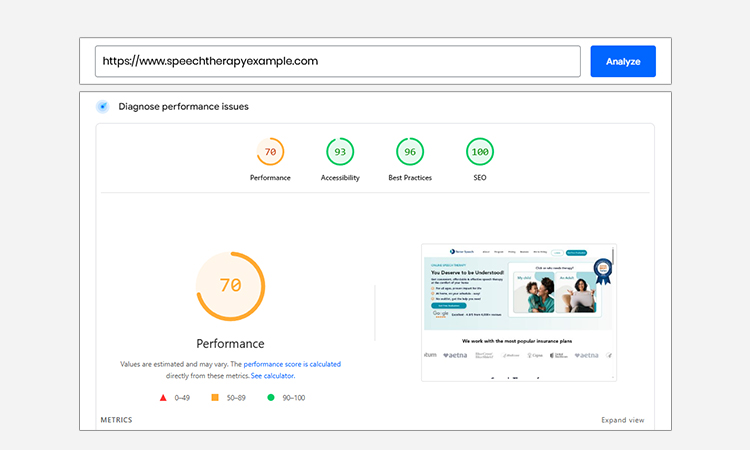
- Check your Website Speed: Make sure to regularly check your page loading speed by implementing tools like Google’s PageSpeed Insights to easily determine and resolve the issues.
- Overuse of AI-Generated Content
While more and more people are turning to AI for literally everything, it is becoming more and more crucial, especially for generating content. However, AI-generated content often lacks authenticity, relevance, and a human touch. In fact, even Google penalizes AI content that lacks uniqueness, human editing, and E-E-A-T.
How Speech Therapists can Overcome it:
- Use AI Just as a Tool and Not a Replacement: Speech therapists must leverage AI for generating ideas, first drafts, and outlines. After you are done generating content from AI tools, you must get it edited and refined by a human expert and incorporate unique, valuable insights and personal experience.
- Focus on Originality: Speech therapy practices must make sure that every piece of content offers unique value to their audience. Make sure to share case studies, personal insights, and specific advice that only an expert speech therapist can offer.
FAQs
Ans. SEO enhances patient discovery for speech therapists on Google by guaranteeing that their practice appears prominently when prospective patients search for relevant speech therapy services.
Ans. High-quality content is vital for speech therapy SEO because it establishes E-E-A-T (Experience, Expertise, Authority, and Trustworthiness), reduces bounce rates by keeping patients engaged, attracts backlinks, and signals to Google that your website is authoritative.
Ans. Common SEO mistakes that must be avoided by speech therapists are keyword stuffing, ignoring local SEO, neglecting user search intent, and developing low-quality content.
Ans. Maintaining consistent SEO efforts can offer a therapist’s practice higher organic traffic, better professional credibility, and more independence from paid advertising in the long run.
Conclusion
While many speech therapy practitioners often overlook this digital marketing strategy as it takes a lot of time to actually show results, SEO for speech therapists is crucial. Search Engine Optimization can not only help improve online visibility but also get more traffic. In the world of growing competition, staying ahead has become more difficult than ever. By strategically implementing the SEO strategies mentioned above, speech therapy practices can not only enhance their speech therapy practice but also position their business as an authoritative source in the speech therapy market. However, managing a speech therapy practice and regularly monitoring your SEO performance is almost impossible. So, in this case, we recommend partnering with an established healthcare SEO agency that offers exceptional and personalized search engine optimization services.

