


In an industry like healthcare that is based solely on trust and credibility, effective online reputation management for hospitals is vital in order to shape public perception, foster patient trust, and generate good revenue. With 90% of patients trusting online reviews as much as they trust personal recommendations, online reputation management ensures positive visibility on platforms like Google, Yelp, and Healthgrades.
By implementing effective online reputation management strategies, hospitals and clinics can not only attract the right patients but also enhance their search engine rankings and mitigate damage from negative feedback.
If you are a healthcare professional who is looking to establish a positive image online for hospitals, then this blog is for you. It will discuss how to improve hospital online reputation, why hospitals must invest in online reputation management, best ORM practices for hospitals, common ORM challenges, and more. So, ready to get started?
Understanding Online Reputation Management for Hospitals?
Before we jump into the importance of online reputation management for hospitals practices, let us take a quick look at what hospitals reputation management is:
Online reputation management for hospitals is the strategic process of influencing, monitoring, and managing the online presence of a healthcare provider in order to foster trust and attract new patients.
Major Components of Effective Online Reputation Management:
- Tracking Reviews: By actively monitoring feedback across various platforms, such as Google and Yelp, to determine public perception.
- Encouraging Feedback: This is one of the most crucial components of online reputation management. Reaching out to happy patients and asking them to share their experiences with your hospital in-person or through automated follow-up emails and texts is very important.
- Responding Professionally: Responding to both positive and negative feedback gently and empathetically, showcasing a strong commitment to patient satisfaction while strictly adhering to privacy regulations.
- Listing Management: This component includes ensuring accurate and consistent information, such as phone numbers and operation hours, across various online directories.
- Crisis Management: By promptly addressing negative feedback or false information to reduce damage to the practice’s reputation.
Importance of ORM in the Healthcare Sector
Now that we have a clear idea about what online reputation management is for hospitals, let us discuss why ORM matters in the healthcare sector:
- Effectively Manages Online Reputation and Crises
Online reputation management can offer a well-defined framework for addressing negative reviews and eliminating the risks of reputation crises. This allows healthcare providers to turn negative experiences into positive ones, preventing long-term damage.
- Helps Establish a Positive Image
By implementing active patient trust building strategies for hospitals, they can showcase their success stories, patient testimonials, and high ratings on platforms like Google Maps. This guarantees that the initial perception of a patient about your hospital is strong and positive.
- Offers Higher Customer Satisfaction
Through effective online reputation management, hospitals can regularly collect and analyze feedback, which can help identify recurring challenges such as long wait times and make actionable improvements to patient care, leading to higher patient retention and satisfaction.
- Builds Brand Trust and Credibility
As the majority of patients rely on positive patient feedback to determine how good a hospital is, a proactive online reputation management strategy can build trust among patients by showcasing responsiveness and commitment to the well-being of patients.
- Leads to Higher Search Visibility
A strong online presence, often characterised by numerous, recent, high-quality reviews and updated local listings such as Google Business Profile, can not only enhance search engine rankings but also make it easier for new patients to discover your hospital’s practice.
8 Best Online Reputation Management Strategies Healthcare Providers Cannot Afford to Ignore
When it comes to effective online reputation management for hospitals, it can be very easy to get overwhelmed by all the things you are recommended to do.
Although different healthcare organizations may find success with various strategies, here are a few that can be particularly helpful for hospitals seeking to enhance their online reputation:
- Claim and Optimize Your Google Business Profile
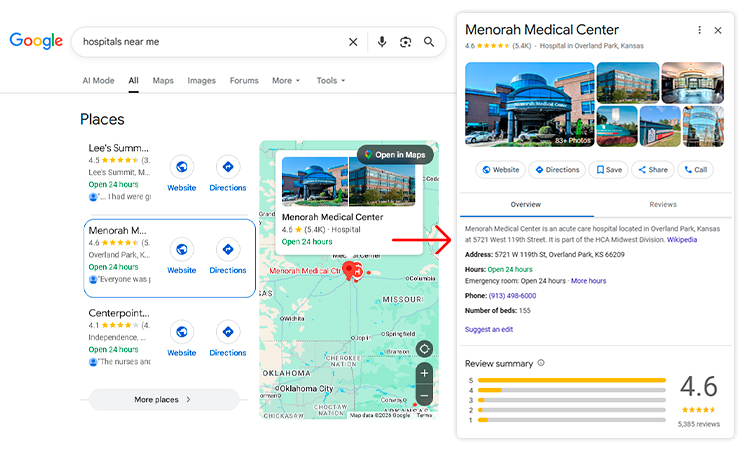
Do you know 16% of businesses receive more than 100 calls per month from their Google Business Profile alone? This statistic highlights the importance of having a claimed and well-optimized Google Business Profile. However, that’s not it. There are a lot of benefits to having a properly set up Google Business Profile.
In this section of the blog, we will discuss why claiming and optimizing GBP matters and how hospitals can do it. So, let’s get into it:
- Why Optimizing Google Business Profile Matters for Hospitals
By optimizing Google Business Profile, hospitals can not only enhance their local visibility but also foster trust and drive patient acquisition.
A business profile that provides complete information and appears in the “map pack” ensures patients find accurate information, such as location and operating hours, and can schedule appointments without hassle, leading to higher engagement and traffic compared to unverified GBP listings.
- Enhances Discoverability
A Google Business Profile that is well optimized can be highly beneficial when patients search for hospitals or healthcare-related services in the close proximity of your clinic.
This can make it easier for patients to find your hospital practice in local search results by securing a prominent position. Ultimately leading to more patients checking out your hospitals, easily accessing vital information, and scheduling appointments seamlessly.
- Accurate Information Fosters Trust
Patients often look for up-to-date details when it comes to exploring a clinic, hospital, or doctors. The address, operation hours, and contact information of a hospital are the information they seek the most.
If they come across missing details, outdated or duplicate details, it might leave customers confused and make them look for other options. In such cases, a well-optimized Google Business Profile can guide patients with real-time, relevant information, allowing them to make quick decisions and foster long-term trust.
- Scheduling Appointment Becomes Seamless
The majority of patients prefer scheduling appointments online rather than calling. With the booking feature of Google Business Profile, patients can easily schedule appointments directly on Google.
For example, suppose a patient is searching for “best dental hospital near me,” and your clinic appears in the top spot, and you book instantly. This not only saves time but also makes the scheduling process easy and hassle-free.
- Reviews can Improve Brand Reputation
When choosing a hospital or clinic, patients never fail to check reviews from other patients.
A fully optimized Google Business Profile that includes relevant reviews, post-treatment photos, and positive reviews can encourage new patients and clearly convey what a hospital actually offers. This can significantly build a positive image and boost the reputation of your hospital.
- Highlight your Products and Services
If you are willing to share a new treatment or special consultation hours, then hospital practices can post them on the updates, offers, and services on their Google Business Profile.
For example, in case you are starting evening consultations, you can add a GBP post saying, “Now Open Till 9 PM for Appointments” This can immensely help hospitals to keep patients informed.
- Step-by-Step Guide to Claim and Optimize Google Business Profile
By optimizing your Google Business Profile, hospitals can maximize their online visibility, attract new patients, and improve local SEO rankings. Here is a comprehensive guide on how hospitals can optimize their Google Business Profile to stand out:
- Optimize your Business Description
The description of your hospital is the first thing that patients will notice when they come across your GBP listing. This often appears right below the business name and should strongly reflect the major values of your hospital.
A short and clear GBP business description must showcase the treatments, specialities, and unique offerings of your hospitals. Hospitals must leverage patient-friendly language to clearly explain why patients should choose their hospital services.
Here are a few steps hospitals must follow when optimizing their business descriptions:
- Firstly, hospitals must sign in to their Google Business Profile.
- Then, they need to click on “Edit Profile” and go to the Business Description section.
- In the same section, hospitals must write a clear, keyword-rich description. For example, “Top-Rated Orthopedic Hospital in Canada offering specialized robotic-assisted joint replacement.”
NOTE: When writing the GBP description, hospitals must avoid keyword stuffing in order to maintain readability and relevance.
- Pick the Right Business Category
This is one of the most important practices of effective online reputation management for hospitals. The business category in your Google Business Profile can help Google understand your hospital services better and show your GBP to the right patients searching for relevant hospital services.
By choosing the right primary category, hospitals can make sure their practice appears in a prominent position in the search results. In contrast, secondary categories can refine the search, making it even more specific.
For instance, if you are running a Neurology hospital, then your primary keyword should be:
- Primary: Neurologist
- Secondary: Nerve specialist, spine surgery specialist, neurosurgeon.
Here are a few steps to follow to update categories:
In order to update categories, hospitals must go to their Google Business Profile dashboard> Click on “Edit Profile“> Business Category> Choose the most relevant primary business category and add a few secondary ones.
- Link your Website and Relevant Social Media Platforms
By linking your website and social media platforms to your Google Business Profile, hospitals can help patients to learn more about their healthcare practice and schedule an appointment seamlessly.
Hospitals must start by adding the link to their official website so visitors can easily explore their contact details, services, and patient resources. A Google Business Profile that is optimized properly can boost credibility and enhance local search rankings.
After you are done adding the link to your official website to your GBP, you now need to link your social accounts, like Instagram, Facebook, or LinkedIn. This will allow patients to see updates, reviews, build trust, and help with community engagement.
Hospitals must follow these steps to add links to their Google Business Profile:
As the first step, hospital practices must go to the Google Business Profile dashboard> Now, select “Edit Profile” and then “Contact“. Then add your website’s URL and the links to your Facebook and Instagram profiles.
- Include High-Quality Photos and Videos
Do you know that businesses with more than 100 photos on Google Business Profile get 2,717% more direction requests than average businesses? By adding high-quality photos to your hospital’s Google Business Profile, hospitals can directly reflect the values, culture, and mission of their healthcare service.
Pictures do create a special impact and help hospitals to stay at the top of the minds of their patients. High-resolution, visually appealing photos of your staff, healthcare experts, waiting areas, and treatment options can not only foster trust but also set your hospital apart from others.
Here is a complete guide on how hospitals can add high-quality photos to their GBP:
Hospitals should start by signing in to their Google Business Profile> Once they are done with that, click “Add Photos” from the dashboard> upload images under categories like team, facilities, cover photo, and logo.
- Add Relevant Attributes in your Listing
Attributes can help your healthcare practice so clearly that patients know what to expect when considering your services. Hospitals can highlight major amenities like “parking” “wheelchair accessible,” “Virtual consultations,” and “board-certified doctors.” These can be immensely helpful to make your hospital stand out from the others.
In order to find and add relevant attributes, hospitals must go to their Google Business Profile> and select “Edit Profile“> Scroll down all the way to the bottom to the “More” section> In this section, you will get additional attributes that you can add if appropriate.
- Collect and Manage Patient Reviews
Trust is the foundation of the healthcare sector. By effectively collecting and managing patient reviews, hospitals can not only build trust but also enhance search engine rankings.
Positive reviews can not only boost credibility but also significantly influence prospective patients’ decisions. Google prioritizes businesses with high-quality, positive, and frequent reviews, improving visibility in the local search results.
By encouraging satisfied patients to share their valuable experiences with your hospital through direct email or a social media link.
Hospitals can follow these steps to request reviews from their patients:
In order to start collecting patients’ reviews, healthcare professionals must go to their Google Business Profile dashboards> “Get More Reviews“> Now, copy the review link and share it through email, social media, and SMS> Respond to all reviews, thanking positive comments and addressing concerns promptly and professionally.
- Enable Q&A’s to Answer Common Patient Queries
For effective online reputation management for hospitals, enabling Q&As is a must. Patients often have a lot of queries when choosing a doctor. For instance, they might ask questions like, “Do you offer same-day appointments?” or “What insurance do you accept?”
Google Q&As allows patients to ask their common queries directly on your profile instead of calling. Hospitals must take the initiative to answer them quickly in order to offer valuable information to the patients before anyone else does. Moreover, hospitals can also add common FAQs that can guide patients better.
You can follow these steps to answer common patient questions:
Firstly, hospitals need to navigate to their Google Business Profile dashboard> and then select “Q&A“> After that, make sure to review questions and provide relevant responses to them> Pre-fill common queries such as “Does this hospital accept insurance?”
- Highlight your Treatments and Hospital Services
By listing all their services in their Google Business Profile, hospitals can make it easier for patients to find the right treatments for themselves. A clear, detailed service list can not only enhance visibility but also attract the right audience.
Follow these steps to add relevant services to your GBP:
To get started, hospitals must go to their Google Business Profile dashboard> “Edit Profile“> “Services“> Click on “Add Services“, then enter a name and write a short description> Now, add pricing details if applicable.
- Encourage Patients to Leave Their Valuable Reviews

In a world where patients always turn to reviews when choosing a healthcare provider, hospitals must make sure to ask satisfied patients to leave their valuable reviews.
With the emerging number of hospitals globally, patients are left with an abundance of options. However, when it comes to health, people want the best for themselves, so 88% of patients trust online reviews as much as they trust personal recommendations.
So, in this section, we will take a look at some of the major advantages of patient reviews for healthcare practices and how hospital staff can encourage patient feedback.
- Importance of Patient Reviews for Hospital
- Online testimonials from patients on platforms like Healthgrade and Yelp can serve as social proof, making potential patients feel more confident about their decision of choosing you as their healthcare provider.
- Feedback from real patients can help hospitals identify common patient concerns, such as communication issues and long waiting times, and allow for improvement that not only boosts patient satisfaction but also retention.
- Consistent posting of reviews tells search engines that your hospital is reputable and legit. This can significantly boost local search engine rankings and visibility.
- By analyzing both positive and negative feedback, hospitals can not only identify their strengths but also the gaps, leading to offering high-quality care.
- A good flow of positive reviews can set your hospital apart from the others, acting as a powerful yet cost-effective marketing tool.
- How Can Healthcare Practices Encourage Patients to Leave Reviews
Asking patients to leave reviews does not always have to be awkward or terrifying. But with the right strategies, hospitals can seamlessly incorporate review collection into their regular workflow. Here are some effective strategies for hospitals to get more patient reviews.
- Automate the Process of Review Collection
Automation often ensures consistency and allows your staff to focus on high-priority tasks rather than reaching out to every other patient asking for reviews. Hospitals can implement tools such as Review.io or Trustpilot to automate review invitations through text and email after appointments.
Platforms like DemandHub can be incorporated with practice hospital reputation management software to send tailored messages to patients post appointments. - Reach Out to Patients at the Right Time
Remember, timing matters the most when it comes to collecting reviews from patients. Do you know, asking for patient feedback immediately after their visit ensures a fresh experience in their minds, leading to higher response rates.
Hospitals must train their staff on how to encourage patients during peak satisfaction moments, like when thanking them for visiting your hospital.
- Tip: Hospitals can provide a QR code that leads directly to their Google Business Profile in the clinic rooms and at the front desk.
- Make the Review Sharing Process Easier
For successful online reputation management for hospitals, it is crucial to make the review-sharing process easier. If you want to get more reviews, make sure it is easy for patients to leave reviews. Now, how can hospitals simplify the process? By sharing direct links of review platforms through emails or SMS. The fewer efforts patients have to put in, the higher the likelihood of them following through.
Hospitals can offer a small discount or a thank-you card on their next visit as a token of appreciation for sharing their reviews. - Leverage Social Media Platforms to Engage Patients
Hospitals should not use social media solely to share updates but also to engage with patients on a more personal level. By sending post-visit thank you notes to your followers and gently encouraging them to share their experiences, hospitals can encourage patients to leave reviews.
Sample Message: “We would like to hear about your experience with us! Please leave us a review to help others find great care [Review Link]”
- Respond to Reviews Instantly and Professionally
People are more likely to share a negative customer experience in comparison to positive ones. However, the majority of businesses make the mistake of keeping them unaddressed. In fact, 89% of customers expect a response to their reviews, so businesses cannot afford to ignore them.
Missing out on this opportunity might make hospitals lose the opportunity to establish a robust relationship with patients. Addressing reviews instantly- whether positive or negative might make patients feel like your hospital values their feedback and is open to making improvements.
- Sample Response for Positive Reviews: “Hi Betty, thank you for taking the time to share your experience! We are glad you had a great experience with us. Hope to see you again”
- Sample Response for Negative Reviews: “Hi Charles, thank you for bringing this to our attention. We are very sorry to hear that your experience with us did not meet your expectations. We take feedback seriously and would love the opportunity to make this right for you. Please reach out to us directly at [Phone/Email] so we can do our best to resolve it“
- Leverage Text Messaging to Request Reviews
Texting is one of the fastest ways to reach new patients. Hospitals must ensure HIPAA compliance and send short, friendly texts with a link attached to their preview page.
Sample Message: Hi Marcus, thank you for visiting us! We’d love feedback. It will help us keep getting better. Leave us a quick review here [Link].” - Set Up a Process and Train your Staff
It is crucial for hospitals to incorporate a process that creates a great first impression for patients. Hospitals must set up a welcoming environment, instant intake, and effective communication. Every staff member must be well-aware of their role in encouraging patients to share reviews and the impact on the business.
Hospitals must offer comprehensive training sessions to educate staff on how to reach out to patients gently and ask for reviews politely. - Deliver Highest Quality Patient Experience
An exceptional patient experience is the core of good reviews. hospitals must make sure to edge the basics, such as shorter waiting times, a warm environment, and empathetic care like no one could offer.
Remember, happy or satisfied patients can become your biggest advocates by sharing their valuable experience with your practice.
- Handle Negative Feedback Like a Pro
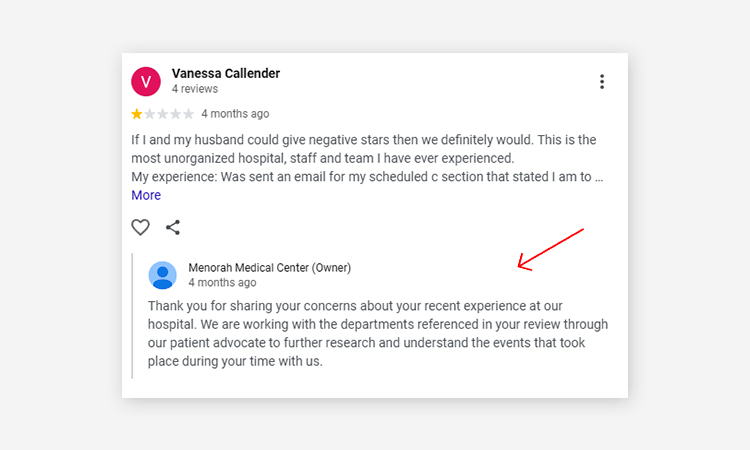
This is one of the most important strategies for online reputation management for hospitals. In today’s ever-evolving healthcare sector, even a single negative review might make patients reconsider their decisions. 94% of businesses say that they will avoid a business if it has been rated negatively online.
Dealing with negative reviews can be very difficult, whether it is a performance review or a comment from patients. So, if you are a healthcare practice that is receiving a lot of negative reviews, then here are a few tips and tricks hospitals can use to manage negative feedback successfully.
- Respond Promptly to Negative Reviews
Let’s face it, patients leave negative reviews for specific reasons. Some want to share their negative experiences, while others want to feel seen and heard.
By offering a thoughtful, accurate, and timely response, hospitals can not only eliminate the damage caused by the negative review but also showcase to the reviewer that their feedback matters for your healthcare practice. It also enables hospitals to offer a timely solution to the issue, if applicable. - Thank the Reviewer for Sharing their Reviews
Hospitals must make sure to thank the reviewer for sharing their feedback. By doing so, hospitals can not only show patients that they value their feedback but also appreciate their time and efforts. This is a great way to overshadow the negativity. - Be Precise, But Address Concerns Directly
Hospitals should respond courteously without apologizing and keep the message as brief as possible. Make sure to thank the reviewer for their reviews, let them know your hospital is the best to see patients on time or reduce the waiting time, and ask them to reach out directly. - Act Professionally and Privately
Rather than getting defensive, insulting, or making any kind of excuses in public forums. Instead of that, hospitals must offer a brief and professional response and try to move the decision to a private channel, such as email and SMS, in order to directly address the specific grievance. - Strictly Adhere to HIPAA Regulations
Hospitals must avoid making a reviewer confirm if they are a patient or ask them to disclose any Protected Health Information (PHI) in a public response, as it goes against HIPAA regulations. - Apologize with Empathy
Healthcare providers must ensure they properly apologise for a patient’s negative experience or perception of the situation rather than admitting fault immediately. - Observe for Improvements
Make sure to leverage feedback in order to identify potential issues and enhance operational procedures. - Take Public Feedback
Hospitals must regularly request feedback from happy patients to weaken the impact of occasional negative reviews and showcase an authentic, transparent profile.
- Establish a Robust, Active Social Media Presence

In this social-media-driven world, having a strong social media presence, even for hospitals, is non-negotiable. In this section of the blog, we will discuss the role of social media in reputation management and how hospitals can build and maintain a solid social media presence.
- Role of Social Media in Reputation Management
Key roles of social media for effective reputation management:
- Real-Time Crisis Management: Social media can be a great tool to immediately respond to crisis situations and prevent the spread of negative sentiment. Proactive communication during a crisis, including issuing apologies or explaining corrective actions clearly, demonstrates accountability.
- Dynamic Brand Monitoring: By leveraging tools like Hootsuite, Google Alerts or Brand24 to analyze brand mentions, sentiment, and hashtags, that allows hospitals to stay prepared for potential risks or crises.
- Establishing Trust and Authority: Engaging directly with customers by responding to their messages, reviews, and comments showcases that your hospital values its audience and their loyalty.
- Shaping Public Perception: By sharing compelling stories, curating content, and highlighting company values, brands can actively foster a positive reputation.
- Partner with Influencers: Partnering with renowned influencers can not only enhance credibility but also help manage a brand’s image through authentic endorsements.
- Collecting Customer Insights: Tracking social discussions offers feedback, allowing hospitals to improve their services and products to better correspond to customer expectations.
- Tips to Establish and Manage a Strong Social Media Presence
For effective online reputation management for hospitals, building and managing a robust social media presence is crucial. Here are a few valuable tips to build and maintain a robust social media presence:
- Choose your Social Media Platform Wisely
Choosing the right social media platform for your hospital is crucial for reaching the right patients. Focus on the platform where your audiences are the most active and engaged.
Hospitals must avoid overwhelming themselves to get popular on every social media platform. For hospitals, social media platforms like LinkedIn, Twitter, and Facebook might be the best suited for them.
- Post Regularly
In social media, consistency is the key. If you are not consistent, you are likely to lag behind in the competition. Hospitals must create a proper content calendar and post at least once a week on each platform they are active on.
- Engage with your Audience
Social media is a two-way conversation. Hospitals must make sure to respond to comments and messages instantly and professionally, and make an effort to interact with their audiences by liking and commenting on posts that mention their brand.
- Develop a Content Calendar
By planning your content in advance, hospitals can stay organized and make sure that they are consistently sharing content that perfectly corresponds to their brand and messaging. Implement tools like Trello and Google Sheets to create a proper plan for your content for every week and month.
- Keep your Content Fresh
Do not be the person who shares the same link again and again. Your patients have seen it; they don’t want to see it again.
Patients always look out for fresh, new, and compelling content that is unique and stands out in the heavily competitive market. Hospitals must focus on developing content that will make readers stop scrolling and engage with your content.
- Measure the Outcomes
Hospitals must keep track of their social media metrics to determine what is working and what is not. By leveraging tools like Hootsuite or Google Analytics, hospitals can track likes, shares, and engagement. This crucial information can be incorporated to adjust your social media strategy over time.
- Develop and Share High-Quality, Authoritative Content
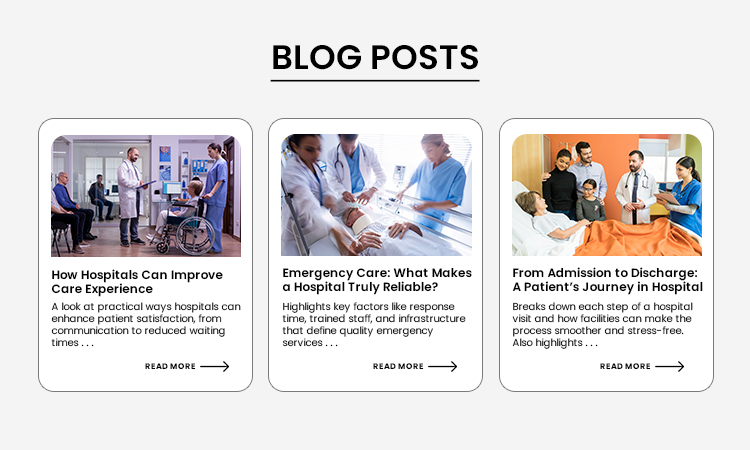
Content is one of the most important reputation management strategies. However, a lot of healthcare practices often ignore this strategy. By creating and sharing authentic, high-quality, and authoritative content, hospitals can shape their online narrative, foster trust, and suppress negative comments.
This strategy of reputation management will discuss how hospitals can create quality content, the types of content they can create, and provide a complete guide to creating valuable content.
- How can High-Quality Content Creation Build Reputation for Hospitals?
Here is how quality content can establish a reputation for hospital services:
Fosters Trust and Authority
- Expertise-Led Content: By producing in-depth articles, whitepapers, and videos on specialized healthcare topics, whether it is written or reviewed by a staff physician, your hospital can position itself as a trusted source rather than just a mere healthcare service provider.
- Addressing Search Intent: Offering answers to common health queries, such as treatment options, recovery tips, or symptoms, is crucial for fostering credibility and becoming a go-to source for healthcare information.
- Dealing with Misinformation: Providing accurate, evidence-based content can help deal with misinformation, maximizing the hospital’s reputation as an authoritative and ethical healthcare institution.
- Humanize your Healthcare Brand and Boost Patient Experience
- Patient Stories and Testimonials: By sharing authentic, compelling, and touching stories of successful treatments and empathetic care offers “social proof,” which is very valuable for fostering trust in comparison to traditional advertising.
- Behind-the-Scenes Content: Videos showcasing facility tours, hospital staff, or community involvement make your hospitals more relatable and approachable.
- Supporting the Patient Journey: Content that guides patients through the entire care process, such as preparing for surgery or understanding insurance. This reduces the anxiety of patients and showcases that the hospital cares about their patients’ experience, not just the clinical results.
- Drives Visibility Through Local Search and SEO
- Optimized Content Strategy: By developing high-quality content that is well-optimized for SEO by using relevant keywords, healthcare professionals can make sure that their hospitals appear in a prominent position in the search results, boosting visibility and driving organic traffic.
- Local SEO and “Near Me” Searches: Hospitals must create content strongly focusing on local health issues or community-specific events that can help hospitals rank for “near me” searches, attracting patients in their immediate areas.
- Create Content Clusters: By creating content around specific “winnable” topic spaces, such as comprehensive in-depth guides for a specific healthcare service line, showcases depth and expertise, allowing hospitals to outrank broader, less specific sites.
- Enables Dynamic Reputation Management
- Responding to Reviews: Responding to reviews is vital for effective online reputation management for hospitals. Leveraging content to respond positively, thoughtfully, and empathetically to both good and bad reviews shows the public that your hospital is transparent, values patient feedback, and is dedicated to constant improvement.
- Crisis Management: Active, accurate communication during healthcare crises or emergencies can help combat misinformation, strengthening the hospital’s image as a stable and reliable leader.
- Types of Content Hospitals Can Create
For effective reputation management, hospitals can create several types of content. Here are a few of them:
- Educational Blog Posts and Articles: By developing blog posts and articles that directly address common health queries, explain complex procedures, and provide wellness tips, hospitals can build authority.
- Case Studies and Patient Testimonials: Hospitals must share patient success stories with proper consent in order to build trust and social proof.
- Provider Instruction Videos: Short videos that clearly introduce doctors and staff can not only help hospitals to humanize their practice but also make patients feel more confident about their decisions.
- Educational Videos and Infographics: Hospitals must focus on creating easily digestible content that explains complicated health topics that is easily shareable on various social media platforms.
- Patient Focused FAQs: Another type of content that is immensely crucial to create for hospitals is content that directly addresses common concerns or fears of patients regarding treatments.
- Community Engagement News: Content such as blog posts and press releases about sponsorships, local events, and new healthcare services offered can be very effective to keep patients informed and engaged.
- Behind the Scenes and Staff Highlights: Clear videos and photos showcasing every staff member can foster a strong sense of community and transparency.
- A Comprehensive Guide to Developing Effective Content for Hospitals
If you are a healthcare practice that is willing to develop effective and compelling content, then you must follow this step-by-step guide.
- Create a Well-Documented Content Strategy
- Set up SMART Goals: The first step to developing good content for reputation management is to clearly define Specific, Measurable, Achievable, Relevant, and Time-bound goals. For example, “boosting website traffic by 20%.”
- Understand Target Audience: Hospitals must create patient personas to determine their age, pain points, and health concerns. For example, a newly diagnosed patient vs a long-term patient.
- Audit Existing Content: Make sure to thoroughly assess your current hospital website, social media profiles, and blog posts to determine what resonates the best with audiences and update old information.
- Develop Patient-Focused Content
- Focus on Educating, Rather than Selling: Patients are often overwhelmed or under pressure. Hospitals must create content that clearly answers their common queries regarding symptoms, treatments, and conditions rather than solely promoting their services.
- Leverage Simple Language: Make sure to avoid using heavy medical jargon in your content. Hospitals must make sure their content is clear, concise, and easy enough for a layman to understand. Make sure to write at a level that bridges the gap for adults with a lower health literacy rate.
- Incorporate FAQs: When developing FAQs, hospitals must make sure to turn the top 20 questions that are often asked by patients to their nurses, front desk executives, and practitioners into relevant blog posts, FAQs, and videos.
- Leverage Various Content Formats
- Use Video Content: Do you know that viewers retain 95% of a message when they see it in a video, compared to only 10% when reading a text? This statistic showcases the importance of videos.
However, video content is a crucial aspect of online reputation management for hospitals. By creating short, compelling, and powerful videos of 2 to 5 minutes to explain complex procedures and quick tips, hospitals can humanize their brand and ease patient anxiety.
- Stories or Patient Testimonials: Sharing real-life stories with proper, HIPAA-compliant consent can offer social proof and build immense trust among patients.
- Incorporate Visual Infographics: Hospitals can leverage visual tools to break down complicated healthcare information, such as recovery timelines or anatomy, making that information easy to comprehend and share.
- Blogs and Long-Form Content: By developing in-depth articles on particular conditions and treatments, hospitals can improve SEO and showcase their expertise.
- Optimize for Search and Local Visibility
- Target “Near Me” Keywords: Nowadays, the majority of patients search for local hospitals. When developing content, hospitals must include location-specific keywords as well as maintain an updated Google Business Profile.
- Leverage High-Intent Keywords: Make sure to target keywords that clearly indicate that a patient is ready to schedule an appointment, such as “top cardiologist in Noida” or “Knee replacement recovery tips.”
- Create Topic Clusters: Hospitals must structure their website with a main “service” page, such as “Orthopedics”, that is well-supported by blog posts on relevant topics to fortify SEO. Healthcare professionals can develop content on topics like “arthritis” or “knee pain”.
- Ensure Compliance and Credibility
- Medical Review: Hospitals must have all their clinical content reviewed by certified and qualified medical professionals in order to ensure accuracy.
- Stick to Privacy Rules: Hospitals must avoid sharing identifiable patient data without obtaining written or informed consent from the patients who appear in any testimonial or videos.
- Link Reputable Sources: Make sure to link your healthcare content to peer-reviewed studies, government healthcare agencies, or reliable medical journals to support all your medical claims.
- Distribute and Measure
- Maintain Consistency in Social Media: In order to maintain consistency across social media platforms, hospitals must leverage platforms like Facebook or Instagram to share informative content and not just promotional updates.
- Showcase Your Patient Testimonials
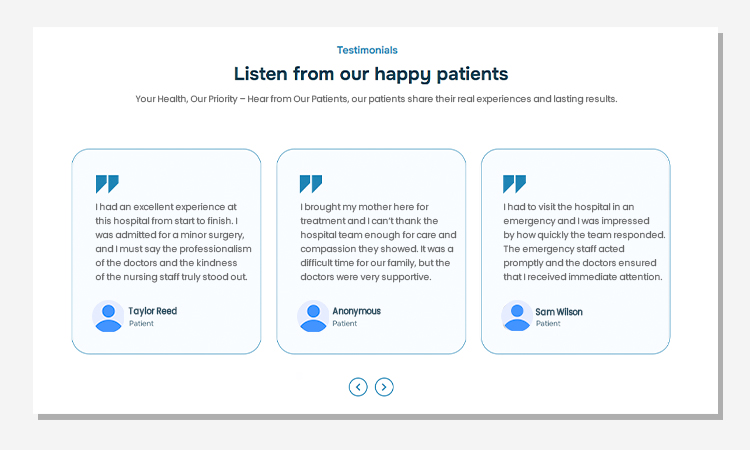
With 92% of customers reading online reviews and testimonials when considering a purchase, they are like super foods for effective reputation management. By showcasing patient testimonials, hospitals can not only build instant trust and credibility among patients, but they also act as social proof to show that real-life patients had positive experiences with their healthcare practice.
Authentic patient testimonials can not only reduce anxiety, but it also influences decision-making and enhances local SEO. So, let’s get into the details of why showcasing patient testimonials matters for hospitals.
- Why is Showcasing Patient Testimonials Crucial for Hospitals?
- Fosters Trust and Credibility
Put yourself in the shoes of your target audience and imagine yourself looking for a cardiologist. The process can be overwhelming, as options are abundant out there. What will you do in such a case? Go for a cardiologist who has the most positive reviews and clearly highlights testimonials from real patients, right?
Patient testimonials play a significant role as a virtual word-of-mouth recommendation, offering a quick look into the experiences of individuals who have trusted their health to your care. - Improves Emotional Connection
Patient stories that clearly outline the journey from their struggles to recovery perfectly resonate with audiences more deeply than generic facts, boosting engagement and helping with decision-making. - Enhance Patient Acquisition and Marketing
Authentic testimonials act as a very powerful, word-of-mouth marketing that attracts new patients and enhances the online reputation of your hospitals. - Offers Authentic Insights
Detailed testimonials from real patients help potential patients to understand the services, care, and daily life with a condition. This holds more power and offers more value in comparison to satisfaction surveys. - Sets your Hospitals Apart
By showcasing unique patient experiences, hospitals can showcase the empathetic, patient-centric approach that sets their hospital apart from their competitors in the market.
- How to Gather Patient Testimonials to Build a Positive Online Reputation?
In this section, we will take a look at how hospitals can gather patients’ testimonials to ensure successful online reputation management for hospitals.
- Use QR Codes for Immediate Access
In order to gather patient testimonials, hospitals must place their QR codes on appointment cards, waiting room posters, or office signage that guides patients directly to their Google review page. - Timing is the Key
Hospitals must ask for a testimonial right after a positive experience. For example, at the end of a treatment process, a successful procedure, or when a patient is highly satisfied with a specific product or service. - Automate SMS or Follow-Up Emails
Make sure to send a quick follow-up email or text message within 24-48 hours of a visit, thanking the patient and offering a direct link to submit their feedback. - Tailor In-Person Automated Review Requests
Make sure to have your front desk staff politely ask patients to leave a review or testimonial at checkout. For example, “We are so glad you are happy with your results. It will be highly appreciated if you could share your story on Google to help others.” - Leverage Targeted Questions
Hospitals must properly guide their patients to provide specific feedback by asking common questions like, “What did you like about our cardiology service?” or “Why did you choose our hospitals?” rather than asking generic questions that everyone has been asking. - Offer Digital Convenience
Make sure to leverage pre-filled surveys or forms that let potential patients leave feedback on their experience with your business in just a few minutes.
- Actively Track Review Platforms Regularly

Doctor review sites impact how a patient searches and chooses hospitals in 2026. Feedback from verified patients, accurate ratings, and a complete profile can not only help hospitals to gain trust but also increase appointment bookings.
In fact, according to this statistic, 84% of patients visit online review sites to assess hospitals. So, we have curated a list of 4 top review sites for hospitals that patients trust the most.
- Google Business Profile
Google Business Profile is a completely free tool that can help local businesses effectively manage their online presence across Google Maps and Google Search.
Creating a listing on Google Business Profile is crucial to acquiring new patients. This is because modern-day patients are likely to go for healthcare businesses that are listed on the first page of Google search results. - Yelp
Although Yelp is best known for restaurant and service business reviews, it is also an exceptional review platform for healthcare professionals. A lot of patients turn to Yelp to search for dentists, chiropractors, and doctors. Especially when looking for local options.
Yelp reviews often appear in a prominent position in the search results, making them a key review site for hospitals. - Healthgrades
This is a go-to source for literally every patient and contains a huge database of hospitals, healthcare professionals, and clinics.
Besides reading reviews on Healthgrades, patients can also access detailed profiles of medical providers, including the services they offer, their qualifications, and patient feedback. - WebMD
WebMD offers tailored health tools and personalized assessments that can help patients identify their health risks, monitor conditions, and set up wellness goals.
What sets this review platform apart is that it can help patients connect directly with physicians based on specialty, location, and the quality of care they deliver, all certified by real patients.
- Maintain Consistency Across All Online Platforms

In today’s digital world, where information travels faster than ever, the way a hospital portrays itself can make or break its reputation. Consistent messaging is a crucial aspect of online reputation management for hospitals.
- Why Is Consistent Messaging Across Various Digital Platforms So Important?
- Foster Trust and Brand Recognition: Remember, consistency breeds familiarity. When a hospital maintains a consistent tone across various platforms, it makes patients feel more confident in trusting a brand.
- Minimizes Confusion and Misinformation: A consistent brand message prevents patients from getting mixed signals, which might confuse them and severely affect their brand perception.
- Fortifies Emotional Connection and Loyalty: A consistent brand experience can build an emotional connection, boost loyalty, and turn patients into advocates. This can be very effective in enhancing reputation.
- Boosts Professionalism: Uniformity across various digital platforms, such as websites, social media, and directories, often reflects reliability. On the other hand, inconsistent brand messaging can confuse patients, eroding trust.
- Enhances Crisis Management: A well-established, consistent, and trusted brand is better equipped to deal with major reputational crises by showcasing a unified, honest, and immediate response.
- Key Strategies to Maintain Consistency Across All Online Platforms
In order to maintain brand consistency, here are some of the major strategies hospitals can consider:
- Set Up Brand Guidelines: Hospitals must clearly define and document their visual identity (fonts, logos, and colours) as well as voice/tone to guarantee uniformity across all communication mediums.
- Centralize Content and Assets: Hospitals must leverage a Product Information Management system, CMS, or shared drive to make sure every staff member can access the same updated materials.
- Develop a Comprehensive Content Calendar: Make sure to plan content in order to maintain a steady, organized presence across various social media platforms rather than infrequent posting.
- Repurpose Content: Conducting workshops and offering resources to ensure every hospital staff has a clear idea and applies brand guidelines.
- Conduct Thorough Audits: Healthcare professionals must regularly review all digital platforms in order to determine and correct inconsistencies.
- Adopt a Min-Max Posting Approach: Make sure to set up a minimum sustainable frequency and a maximum goal for content posting in order to avoid confusion while maintaining a sustainable presence.
How can Hospitals Track the Effectiveness of their Online Reputation Management Efforts?
8 Vital Metrics to Track and Strengthen Your Online Reputation Strategy:
- Review Volume
This is one of the most valuable metrics to ensure successful online reputation management for hospitals. It clearly signals brand popularity, reliability, and consistency. A high, consistent flow of reviews indicates an active business and offers more data to evaluate and measure success. - Response Time
One of the major metrics of reputation management tracks how quickly hospitals should respond to customer feedback. Instant responses can transform negative reviews into positive experiences and showcase value and care. - Response Rate
Response rate signifies the percentage of reviews (both positive and negative feedback) that receive a response. High response rates boost trust as well as search visibility. - Average Star Ratings
This metric measures the velocity of new reviews, the average rating, and the average rating change monthly. A consistent increase in ratings and a boost in total review volume showcase successful review generation efforts. - Sentiment Analysis
Sentiment analysis leverages Natural Language Processing (NLP) to categorize whether patient reviews and feedback are positive, negative, or neutral. By leveraging AI-driven tools, hospitals can assess the tone of reviews and mentions on health forums and social media. - Share of Voice
Share of Voice is the measurement of how much of the local healthcare market revolves around your healthcare practice compared to your competitors.
Hospitals can implement tools like Ahrefs and SEMrush to compare the volume of reviews, brand mentions, and search clicks in comparison to competitor practices. - Visibility in Local Search Packs
Patient reviews and ratings are the most valuable ranking factors in Google’s local pack. Hospitals must track how often their businesses appear in prominent positions, and how performance correlates with review activity. - Branded Search Volume
This metric tracks how often people are searching for your hospital by name. An increase in branded search showcases rising brand awareness and trust. A decline in this metric may indicate reputational issues.
5 Common Reputation Management Mistakes that Hospitals Make and How to Avoid Them
When managing your hospital’s online reputation, even the slightest mistakes can lead to severe consequences. Here are 5 major reputation management mistakes hospitals must avoid at all costs:
- Posting Fake Online Reviews
A lot of hospitals end up making this mistake. The temptation to create fake positive reviews in order to boost ratings can be hazardous to an online reputation.
Hospitals must avoid buying reviews or having their staff post fake testimonials. Google and other search engines have complex algorithms that can easily detect fraud. Posting fake reviews online might lead to penalties, lawsuits, and profile bans.
Furthermore, hospitals must focus on getting more genuine reviews by making it easier for patients to leave reviews. For example, using automated follow-up emails after appointments. - Not Claiming or Updating Online Listings
Ignoring listings on Google My Business, Yelp, or Healthgrade is another major mistake in online reputation management. If your business information is incorrect or outdated, it might confuse patients, leading to frustrations and lost appointments. It can also severely hurt local search engine optimization.
Hospitals must regularly audit their online presence and ensure that the name, address, and phone number (NAP) are consistent across all platforms. - Ignoring or Delaying Responding to Reviews
Ignoring reviews, especially the negative ones, is one of the major mistakes that can make your hospital look indifferent and guilty. A major lag in response can suggest that your hospital does not care or value its patients, further damaging its reputation.
Hospitals must make sure to respond to all reviews within 24-48 hours. Make sure to leverage automated tools that can send an alert every time a new review has been posted. - Getting Defensive While Dealing with Negative Feedback
This is one of the major mistakes of online reputation management for hospitals. A majority of hospitals respond to negative reviews with anger or denial. This can severely hurt the online reputation of a hospital. An emotional or defensive response can escalate a minor complaint, turning it into a public crisis.
Hospitals must implement the “HEAL” approach. Haste (respond instantly), Empathy (apologize for the inconvenience), Address Learn (Fix the issue internally). If required, take the conversation offline immediately by offering to discuss the matter through a call, email, or text. - Underestimating the Power of Social Media
Treating social media as a purely promotional tool rather than a two-way communication channel, or failing to track it all.
Patients usually use social media to directly address their concerns. Ignoring these comments leads to a loss of trust and loss of potential patients.
Hospitals must assign a staff member to track comments regularly. Leverage social listening tools to determine patient complaints and respond in a personal and empathetic tone.
Frequently Asked Questions (FAQs)
Ans. Hospitals can deal with negative reviews by responding to online reviews promptly with empathy, using the HEART approach (Hear, Empathize, Acknowledge, Respond, Thank).
Ans. Hospitals should avoid ignoring negative reviews, using generic responses, violating patient privacy, and neglecting multiple platforms. Not acting on patient feedback is another major mistake, as it limits improvement and harms trust.
Ans. Hospitals should actively monitor platforms like Google Business Profile, Practo, Justdial, Facebook, Healthgrades, and other healthcare-specific directories where patients leave feedback.
Ans. Positive reviews, high ratings, and consistent engagement improve local SEO signals, increase click-through rates, and enhance visibility in Google’s Local Pack and organic search results.
Ans. A reputation management agency can help hospitals establish a strong online image by proactively tracking brand mentions, suppressing negative through SEO, generating positive reviews, and handling social media crises.
Ans. Average rating, review volume, response time, sentiment score, patient satisfaction rate, and conversion from online inquiries.
Conclusion
In conclusion, in the evolving healthcare sector, hospitals are striving to establish a strong online reputation and fighting to gain the trust and attention of patients; effective online reputation management for hospitals is non-negotiable. By incorporating the 9 effective strategies of ORM for hospitals mentioned above, hospitals can not only foster trust but also position themselves as a go-to source in the healthcare sector.In case you are a healthcare professional who is just starting out and has no idea how to proceed with online reputation management, then you can perhaps consider partnering with an expert online reputation management agency for Hospitals.

