


Do you know that residents of the USA send approximately 10 billion emails every day? This statistic showcases why businesses must consider email marketing especially in the case of pathology labs. When it comes to their health, people often go for the best option. With the rising number of pathology labs, it will be incredibly difficult to stand out. By implementing effective email marketing strategies for pathology professionals, you can gain a direct, tailored, and cost-effective way to engage the right patients.
Now, you might be wondering why this digital marketing strategy stands out from the rest? According to this statistic, 4.24% of visitors from email marketing are likely to buy, compared to only 2.49% from search engines and just 0.59% from social media.
If you are still confused about how email marketing can advantage your pathology practice, then this blog is for you. It will discuss what email marketing is for pathology labs, why pathology professionals must invest in it, effective email marketing tips, and more. So, let’s get started.
What is Email Marketing for Pathology Centers?
First, we will clarify the concept of email marketing for pathologists. Email marketing is a digital marketing approach that includes sending relevant emails to patients who are looking for pathologists. These emails are often sent to current, potential, and inactive patients.
Email marketing for pathologists involves leveraging targeted, verified pathology email databases to reach the right patients. Your emails can be a very powerful tool to fortify connections with patients and foster loyalty.
5 Convincing Reasons Why Pathologists Must Invest in Email Marketing
Now that you have a clear idea of what email marketing is, let’s take a look at all the advantages that email marketing can offer to top pathologists:
- Offers a Higher ROI and is Cost-Effective
Email marketing is one of the most cost-effective digital marketing tools available. Owing to the simplified and automation-friendly nature of emails, email marketing delivers one of the highest ROI in comparison to every other digital marketing strategy. According to Campaign Monitor, for every $1 spent, email marketing generates $38 in ROI.
- Provides Direct Access and Better Visibility
Unlike social media, which is constantly subjected to changing algorithms, email marketing for pathology practices offers direct access to the inboxes of potential leads. This guarantees higher visibility, as healthcare-related emails have an average open rate of 41.23% outshining any other digital platforms.
- Builds Stronger Relationships with Referral Sources
For pathology professionals, maintaining powerful connections with patients or referring physicians is crucial. Sending regular, tailored updates and informative content can help pathology practices to position their lab as an authoritative source. This can foster trust among potential patients, making your pathology practice their go-to for any diagnostic needs.
- Delivers Measurable Results and Data-Driven Insights
Email platforms offer accurate data such as click-through rates, open rates, and conversion rates. These valuable insights can allow you to monitor the effectiveness of your communications, allowing you to refine your email marketing strategy based on the preferences of your target patients.
- Better Patient and Partner Retention
Maintaining consistency in communication can keep your practice in the spotlight. Automating timely reminders, healthcare tips, or new medical equipment launches fosters long-term loyalty and guarantees that patients, as well as specialists, remain engaged with your practice over time.
Types of Emails Healthcare Professionals Must Send
Healthcare is a sensitive topic, and not all emails are fit to be sent to individuals who are looking for healthcare solutions. So, here are a few specific types of emails that pathologists can consider sending to their audience:
- Social Media Updates
While some patients often feel skeptical about getting involved with pathology practices through social media, others are eager to engage with healthcare organizations and relevant professionals on these forums. Emailing patients about your practice’s social media activity gives them a great opportunity to explore what is going on with your pathology practice and team of specialists.
Social media can be an exceptional tool to drive patient engagement on your website or popular review sites. By incorporating a direct link to review sites or websites, pathology clinics can allow patients to be proactive.
Notifying patients of social media activity through emails can immensely help boost online engagement, which is crucial for any business trying to bolster their online presence in the heavily crowded market.
- Welcome Emails
This is one of the most important types of emails that pathology practices must consider sending to their clients. Pathology practices can somewhat take it as an honour that their patients are handing over their email addresses to a business, so the least you can do is thank them.
By doing so, pathology practices can make their journey more welcoming and make them feel more comfortable.
Within the welcome email, start by greeting them with a hello and then link out to other relevant platforms, such as social media, that they might be interested in. Pathology professionals can also link to their medical products or service pages so that patients have a clear idea of what your practice offers.
- Monthly Newsletters Emails
“Newsletter” is certainly not something you have not heard of. You might already be sending out one. However, there is a great way to do a newsletter.
Pathology practices can create and send out an email newsletter to their clients or patients, weekly or monthly. Sending out monthly newsletters can be effective, as it is best not to irritate them with constant messaging. Through a newsletter, pathology practices can keep everyone informed about everything that is going on in their practice.
Not only do newsletters help pathologists keep everyone connected to their practice, but they are also an effective strategy for email marketing for pathology practices that makes patients feel like they are a part of your community. This is a great way to ensure loyalty among your patients.
- Educational Emails
Sometimes, patients are just eager to learn more about your industry and how to take better care of their bodies. By letting patients know about informative opportunities such as blogs, webinars, eBooks, and podcasts, you are showcasing that you value client education and want them to make informed decisions rather than forcing your services on them.
Through an email marketing tool, it is possible for you and your team to better understand what type of educational emails your patients find appealing.
- Patient Satisfaction Survey Emails
Sending out relevant surveys now and then- maybe once or twice a year to all your clients is a great idea. Within the survey, pathologists can include questions on how patients are finding the service they offer and if there is any room for improvement.
In today’s business world, irrespective of the sector you belong to, it is all about being customer-centric and offering an exceptional patient experience. By sending relevant surveys, pathology practices can personalize experiences for patients.
- Follow-Up or Care Instructions
Emails that are sent to follow up on how a patient is doing after a procedure or offering pre-test tips. These types of emails are crucial to be included in your email marketing strategy in order to maintain a professional, sales-driven, and healthcare-related relationship.
This significantly boosts conversion as well as engagement rates. Follow-up emails serve as gentle reminders, keeping your message at the top of a recipient’s inbox.
- Appointment Reminders
Pathologists can send automated confirmations and reminders for biopsies or consultations that can immensely reduce no-shows. These emails are often concise, highly personalized, and sent at strategic intervals in order to minimize no-shows.
Pathology practices can include details like time, date, location, a link, and an actionable CTA to confirm or reschedule an appointment.
- Billing and Invoice Inquiries
Another very important type of email that pathology practices must send to their patients is billing emails. By sending these emails, pathology labs can ensure financial transparency, maintain regulatory compliance, and enhance cash flow.
Owing to the complex pathology services, which often include multiple lab tests, clear, detailed, and prompt communication is non-negotiable. This can help reduce confusion among patients, prevent payment delays, and enhance patient satisfaction.
11 Effective Email Marketing Tips For Clinical Pathology Labs
Incorporating the best email marketing tips can not only help pathology practices to optimize open and click-through rates but also foster a long-term relationship with their patients. This can enhance brand perception but also boost final conversions.
Here are some helpful email marketing tips on how to increase pathology test bookings with email marketing:
- Use a Professional Email Address
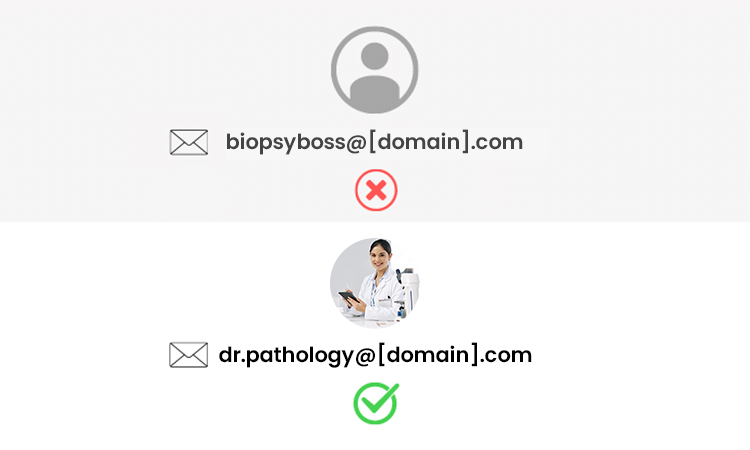
The first step to ensure a successful email marketing for pathology labs is to pick a memorable and professional pathologist’s email address to use. Pathologists should make sure their email address is memorable enough so that patients can differentiate their pathology practice from others.
Pathology labs must link their email address to an email mailbox and have someone from their team check it regularly. This indicates to patients that you are listening to their queries and suggestions.
- Clearly Identify and Segment your Audience

Now that you have an email address, you need to determine who to send emails to. Identifying your audience is the key to taking the full advantage of what email marketing campaigns have to offer. Patients who are looking to receive emails about topics and issues they are genuinely interested in are likely to open the email and click on the links.
In order to keep patients informed about the latest health-related topics that they are eager about, it can enhance engagement rate, leading your email campaign towards success.
Now, you must be wondering, why is audience segmentation crucial for email marketing, right? So, here are a few reasons why segmentation is crucial:
- Offers a More Relevant Patient Communication: By targeting your messages on the basis of segments, pathologists can send more personalized messages to every audience and offer information on new diagnostic tools or services that meet their unique preferences.
- Effective Consideration of Different Stages in the Patient Journey: Pathology practices can create dedicated segments for interested potential, loyal, new, and inactive patients.
- More Patient Satisfaction and Brand Loyalty: Email content that aligns perfectly with the recipient’s interests and characteristics can offer higher engagement and customer satisfaction.
- Better Patient Insights: Effective segmentation can help pathologists to have a clearer idea of the behaviour and needs of each target group. For instance, newsletter tool reports can allow pathology clinics to monitor how each audience segment is responding to targeted messages.
Key Segmentation Strategies for Pathology Laboratories
- By Referring Physician Speciality: Segment audiences effectively to send relevant, targeted research, case studies, or latest updates on new diagnostic markers.
- By Test Volume and Intensity: Identify high-volume referrals to ensure tailored reach, such as offering dedicated support lines, exclusive or advanced testing updates, and quicker turn around times.
- By Level of Engagement: Create segments based on email communications (e.g., active vs inactive) to re-engage inactive users or send exclusive, high-value content to loyal patients or partners.
- By Geographic Location: Pathology practices need to target local hospitals or clinics with region-specific services, such as local laboratory hours, in-person educational healthcare events, and new carrier routes.
- By Patient Interest or Demographic: For the direct-to-patient services, pathology practices must be segmented by age or health interests in order to send tailored, preventive healthcare information.
- By Role/ Key Decision-Maker Type: Segment healthcare procurement staff from clinicians to personalise the value proposition.
- Take Time to Develop Compelling Subject Lines

This is one of the most effective strategies for effective email marketing for pathology professionals. A subject line is one of the most crucial elements of an email. In fact, 47% of email recipients open emails based on email subject lines. To prevent emails from getting ignored by patients and truncated by email platforms, pathologists must keep their email subject lines brief and effective, which offer a clear preview of the content inside without being misleading.
Here are a few ways how pathology practices can create subject lines that trigger clicks:
- Focus on Personalization
Use Appropriate Recipient Names: Do you know that personalized subject lines can maximize open rates by 50%. This statistic showcases the importance of personalization in emails.
When sending emails to patients, pathology labs must include the sender’s name. This can immensely help boost engagement. For example, “Friendly Reminder- Your Upcoming Appointment on [Date]”
- Consider the Character Limit of Subject Lines
Similar to webpage titles, email subject lines also have a specific character limit. By creating subject lines within the specific characters, pathologists can ensure their subject lines are not getting truncated and are clearly visible on every device.
When writing the subject line for your emails, focus on keeping it within 40-50 characters. Place the most important keywords at the beginning of the subject line to ensure they do not get cut off.
- Leverage Preview Text
The preview text or preheader text is basically the snippet of your email that often appears right beside the subject line in the inbox. This text is crucial to add as it offers a preview of what is inside the email.
It is like a supplement to the subject line by adding more context to it. Pathology practices must make sure the preview text successfully supports and enhances the subject line, offering additional context.
Note: Never leave it blank. It basically acts like a subheading, so do not forget to make it count.
- Avoid Spam Triggers
Spam triggers are basically keywords that are often considered spam by both email providers and recipients. For example, “ Completely Free,” “Exclusive,” and “Urgent.” When creating subject lines, pathology practices must avoid using these words to prevent their emails from ending up in the spam folder.
- Keep the Email Content Relevant
Segment your email recipients into different groups on the basis of specific criteria such as behaviours, demographics, and preferences. It can immensely help pathology practices tailor the subject lines as per the needs and preferences of a specific audience segment, which in turn can increase the likelihood of conversion and engagement.
However, pathologists must always make sure that their subject line clearly reflects their email content in order to meet the expectations of the recipients. Otherwise, patients are more likely to bounce back and mark your pathology emails as spam.
- Leverage Action-Evoking Verbs
Pathology labs must leverage action verbs in order to encourage immediate action, such as “join,” “download,” or “discover.” You can be more creative while choosing the action verbs, depending on the objective of the particular email.
- Tailor Every Email to Keep Them Relevant and Valuable to Patients
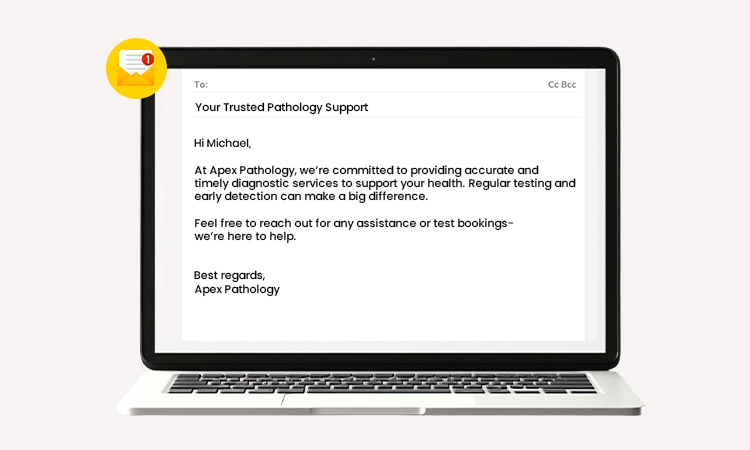
If done right, email marketing for pathology practices can offer exceptional opportunities to establish personal connections with their patients.
Even if you are sending out emails to hundreds of thousands of patients in your pathologist mailing list, do not overlook the importance of personalizing your emails.
How can laboratory medicine brands tailor every email to make sure they are relevant and valuable for patients?
- Enhance Report Readability and Understanding
- Leverage Patient-Centric Language: Break down complex pathology jargon into simple concepts while using the language of your patients.
- Provide Educational Resources: Include relevant links to reliable, patient-focused resources, such as MyPathologyReport.ca, to help them navigate their diagnosis.
- Showcase Key Findings: Pathology practices must clearly state the final diagnosis and focus on the report’s most critical elements.
- Segment and Personalize Communication
- Personalize by Condition: It is crucial to segment the patient list on the basis of specific conditions. Pathology practices must segment their communication by test type to send highly targeted, relevant information.
- Emphasize on the “Why”: Pathology practices must ensure that the emails they are sending clearly explain the clinical significance of the findings, and not just complex data.
- Leverages Personalized Greetings: When writing emails, pathology professionals must address the patients by their names to foster trust and rapport.
- Improve Value and Convenience
- Set Expectations: Use emails to inform patients when they can expect to receive their results.
- Include Actionable Content: When appropriate, pathology practices must provide clear next steps, such as scheduling a follow-up with their primary patient care physician or relevant link portals.
- Enable Two-Way Communication: Encourage patients to ask questions or offer feedback through meaningful surveys, making the email a sort of conversation rather than simply a one-way notification.
- Guarantee Safety and Compliance
- Ensure Secure Email Delivery: Leverage well-encrypted, HIPAA-compliant platforms in order to protect patient privacy.
- Avoid Using Sensitive Information: Pathology practices must avoid discussing highly sensitive, complicated, or vague results over email. These can be handled better in-person consultations or through telephone calls.
- Verify Identity: Leverage secure patient portals in order to confirm the identity of the recipient.
- Maintain a Consistent Brand Messaging
The more your pathology practice grows, the more brand consistency can become difficult to maintain. Brand identity can get soiled with the increasing size of your company and team.
If you are still wondering why brand consistency matters for email marketing, let’s break it down for you:
- Firstly, having a positive brand image can help pathology labs build brand recognition and trust among their audience.
- Secondly, brand consistency can contribute to strengthening your brand’s values and messaging. It showcases that you are professional and conscious in how you present your practice to your patients.
Now, how to ensure consistency in brand messaging for effective email marketing for pathology practices? In this section of the blog, we will be discussing a few easy steps that pathology practices can follow in order to maintain a brand message in email marketing:
- Establish Clear Guidelines
By creating clear brand guidelines, pathology practices can ensure consistency across various email campaigns. It helps determine who you are as a practice and what makes you stand out, making your practice easily recognizable for patients and building trust among them.
Having these clear guidelines in place can not only make it easier for your team to create materials that perfectly align with their brand identity. Below, we have listed some of the crucial elements these guidelines must contain:
- Colour Palette
Using a consistent colour palette for your pathology practice can have a huge influence on how memorable your pathology practice is.
Nowadays, people operate visually. So, when doing email marketing, your colour palette is the first impression a patient has about your email marketing campaign.
- Logo
Investing in a well-designed logo can be advantageous in the long run. Why? Because it can fortify your pathology practice, your brand identity, and attract new patients.
Moreover, having a unique and memorable logo can make it easier for loyal patients to recommend your pathology practice to their family and friends.
- Images
For effective email marketing, using consistent branding images can help build trust and familiarity among your subscribers. Pathology practices must start by considering what is best for their practice.
For example, they can include images of real people that clearly represent their target audience so that their patients can instantly relate to what they see.
Note: Make sure all your images align with your practice’s unique colour palette.
- Typography
By incorporating consistent typography in emails, pathology labs can boost their professional appearance. This element can help create a unified look and feel- making your emails more memorable to subscribers.
When choosing a typography for your pathology emails, consider both personality and readability. Ask yourself, is the font I am using easy for readers to understand at different screen sizes? Does it correspond to the overall pattern and tone of your pathology practice?
- Frequency
This is one of the most important branding elements that pathology practices must consider when doing email marketing. The frequency at which you will be sending out emails is crucial for maintaining brand consistency in email marketing.
To ensure successful email marketing for pathology practices, considering frequency is a must. If you are sending too many emails, it might leave your subscribers frustrated, leading to unsubscription. In order to avoid overwhelming patients with too many emails, pathology practices must aim for 1-2 emails weekly.
- Leverage a Unique Voice and Tone
Figure out how you want to convey your message to your subscribers. Are you looking for a more professional or friendly tone? Do you want to keep your tone conversational or formal?
In any case, pathology practices can define your brand’s unique tone and voice and stick to it across all email campaigns. Doing this can strengthen trust and support with your subscribers. By incorporating a distinct tone and voice, patients will instantly notice your email in their crowded inbox.
- Use Compelling Email Templates
Let’s face it, your email marketing strategy is incomplete without maintaining brand consistency, and one of the easiest ways to do it is by using engaging email templates.
If you have a consistent email design, our subscribers will be more likely to easily recognize your practice and trust it.
- Write a Consistent Header and Footer
Developing a consistent header and footer in emails can help pathology practices bolster their practice, making it easier for subscribers to recognize and engage with their practice.
Include crucial information like logo, social media profiles, and accurate contact details in the header in order to make it easier for patients to connect with you on various platforms.
- Include Visuals Wherever Possible
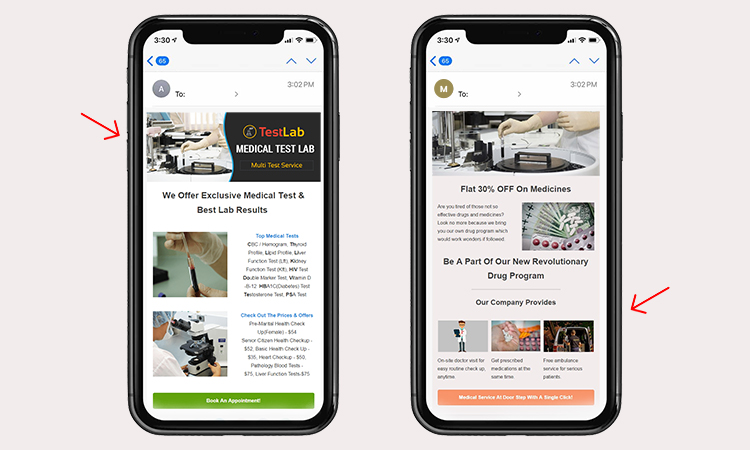
Visuals are one of the most important aspects of email marketing. In fact, emails with images had an open rate of 30.27% and a CTR of 2.78%. So, here are a few types of imagery that pharmaceutical companies can incorporate in their emails:
- Images
HTML coding has made it easier to include images and background colours in your pathology emails, making them more effective for readers. By including relevant emails, pathology practices can avoid long paragraphs and convey more information in the limited space available. 3D images are another type of static imagery that pathology practices can include in their emails.
- Microscopy Snapshots
Static images captured from a microscope clearly represent a specific field of view for an immediate visual reference.
- GIFs or Animated Images
Another engaging visual element that can make your pathology emails stand out in the recipient’s inbox is GID animation. These animated images often consist of various proactive frames that repeat in a loop.
- Cinemagraphs
Cinemagraphs are pretty similar to GIFs. The only difference between a GIF and a cinemagraph is that GIFs are usually derived from a short snippet taken from a video, while a cinemagraph reflects a seamless, endless loop.
- Videos
This is literally the most important type of visuals that needs to be added to emails. Pathology practices can use videos in two formats: add a thumbnail of the video with the play button in the email, or embed the video in the email itself.
- Infographics
Last but not least, infographics. These are some of the excellent resources to consider adding when doing effective email marketing for pathology professionals.
This type of message often consists of a collection of charts, graphics, text, and illustrations. In simple words, infographics are basically collages of words and images. The way infographics convey information can make it very easy for pathology practices to understand better, and also in an engaging way.
Therefore, implementing infographics in email marketing can be a great way to convey a message that could otherwise be too difficult for average people to understand.
- Ensure Creating Mobile-Friendly Emails

With the majority of individuals (85%) accessing emails on their mobile phones daily- and even deleting emails that do not appear on mobile screens properly- optimizing your emails for mobile devices is non-negotiable.
Properly optimizing emails for smaller screens can enhance user experience as well as boost both conversion and engagement rates. Now, how can pathology practices optimize their emails to ensure they are performing effectively on mobile devices? Let’s take a look at it.
- Leverage Well-Responsive Templates: Content is considered responsive when it perfectly adjusts to fit the screen it is accessed from, irrespective of the size. Pathology practices must make use of single-column layouts that automatically adjust content for smaller screens.
- Reduce Image Size: Images with smaller sizes result in smaller emails, making them easier and faster to load. In order to ensure a mobile-friendly email, pathologists must reduce the size of the images and set the image widths to 100% to make sure they truncate without causing horizontal scrolling.
- Truncate your Subject Lines: Email platforms like Gmail and Outlook often cut off subject lines that are too long. So when optimizing your emails for mobile devices, pathology professionals must keep their subject lines within 25-30 characters in order to avoid them from getting shortened.
- Develop Readable Links and Buttons: Any buttons or text links should be at least 57 pixels in height and width.
- Test Email Preview Text: Alt text images that are placed at the beginning of a marketing email can automatically get extracted into the email’s preview text. It is highly recommended to send a test email in order to make sure the preview text is appearing as expected.
- Create Compelling Pre-Header Text: Pathology practices must craft engaging pre-header text in order to gain audience attention, as this is often visible in mobile screens.
- Use Thumb-Friendly Buttons: Make the CTA buttons large enough (usually 57 X 57 pixels) rather than just text links.
- Leverage Readable Typography: Pathologists must use large and legible fonts that are easily visible. At least 16 px for body text.
- Avoid Adding Excess Content: Keep the email content concise to avoid the need for users to scroll too much.
- Make your Emails Easily Sharable

“Shareable” Emails are very important to ensure email marketing for pathology practices. Developing shareable emails is an exceptional, cost-effective way to enhance brand awareness, increase engagement, and grow your email list.
By encouraging patients to become brand advocates, pathology practices can reach a secondary audience that trusts their peers’ opinions.
- Why Does Developing “Shareable” Emails Matter?
Let’s take a quick look at why it is crucial to develop shareable emails:
- Expands Brand Reach and Visibility
Creating “shareable” email content can break the constraints of your existing subscriber list. When a reader shares your email with their peers, your pathology practice gets exposed to a newer and wider audience. This increases visibility even without additional advertising efforts.
Furthermore, email content that is not just compelling but is also informative and valuable for your audience is likely to go viral and reach a massive, unstrained audience.
- Fosters Trust and Improves Patient Acquisition
When a friend or colleague shares an email, it is often considered a personal recommendation. This is much more credible than a brand-pushed advertisement.
Encouraging shares can turn existing patients into advocates for your pathology practice. This “Refer-a-friend” approach is very effective in acquiring new, high-quality prospects at a very low cost.
- Boosts Engagement and Conversion Rates
Content that is frequently shared is often perceived as high-value, increasing the chances of it being opened.
Easily shareable emails often include actionable content, encouraging subscribers to share them on various social platforms. This, in turn, can drive traffic back to your website, boosting conversion rates.
- Improves SEO and Digital Authority
Even though social shares do not directly act as backlinks, the increased visibility from sharing your email can lead more patients to discover your website, share your links, and improve your social signals. This can be immensely helpful for boosting search engine rankings.
Consistently sharing educational and valuable information can position your pathology practice as a leader, improving your reputation in the healthcare industry.
- Improves ROI and Offers Growth
On average, email marketing achieves an ROI of 36:1. This showcases that email marketing has a very high ROI. Making your email easily shareable can amplify this return by extending the lifetime value of a single email.
While social media posts have a short life span, a shareable email can be forwarded, saved, and revisited multiple times over a longer period of time.
- How can Pathology practices Make their Emails Shareable?
Here are a few effective tips for pathology practices to make their emails easily shareable.
- Develop Editorial Content
Editorial content should be the major part of your email marketing strategy. While the majority of your email marketing must be promotional emails, daily, weekly, or monthly newsletters should solely consist of content that is especially designed to engage and inform your patients.
In the modern era, where content consumption is very common, subscribers are often looking for information that will help them connect with a specific practice. Blogs and regular updates on your practice’s efforts to be sustainable, or examples of your corporate social responsibility, can be an excellent way to develop an emotional bond with your patients.
If you have a clear understanding of the type of people you are targeting, it can be easier for you to identify major issues, interests, and causes your audience shares. This can help plan good topics for newsletters. When you create articles that successfully connect with readers, they are more likely to share them with their friends and colleagues.
- Include Social Share Buttons
To do successful email marketing for pathology labs, including social share buttons in their emails, is non-negotiable. For making the sharing process easier for audiences, pathology practices must add social share buttons to every email they send out.
These are especially helpful for pathology practices that produce reports, educational or relevant editorial content. By deriving interesting facts and figures and including a “share on social media” link with it, you can encourage email recipients to share your email content.
Social share buttons do not just work exceptionally for your newsletters. Pathologists can add them to their transactional emails, such as appointment confirmations, in order to make recipients share their experiences. Adding social share buttons can make it easier for email recipients to become advocates with just a few clicks.
- Offer Referral Rewards
Referral rewards are a great way to encourage your audience to share your email content with others. Running a referral reward program can motivate recipients to share your emails and share your brand message.
There are various referral rewards approaches that pathologists can incorporate. You can either choose to reward every referral or leverage a point-based loyalty program that gives points for every share- offering extra benefits can help create a more personal connection with your patients. Recipients will start perceiving your pathology practice as someone who values their audiences, which is likely to make them more invested in your pathology practice and share your email content.
Do not forget to include a refer-a-friend CTA in your email marketing to guarantee patients are always aware of the rewards they will receive after sharing your content.
- Add Subscribe Buttons in the Footer
Besides adding an unsubscribe button in the footer, pathologists must also add a relevant link to their email subscription form.
When recipients share your emails, pathologists would want to make the “Subscribe” process as easy as possible for them. By including a subscription email in the footer of all your emails, you will never miss a chance to extend your verified pathologists email list.
- Write Clear CTAs for Every Email

Do you know that emails with a single CTA can receive 371% more clicks? Including a relevant CTA in your emails is one of the most important aspects of effective email marketing for pathology clinics. As they can help tell recipients what exactly they need to do in the next step. This can help directly drive conversions, boost engagement, and minimize user friction.
Suppose you have created an exceptionally good email that is receiving above-average open rates. The content is pretty good, but the click-through rates are not performing as expected.
The problem here is not with your email subject line or images. Instead, this issue could be due to a minor element missing from your email that plays a crucial role in its overall success- an effective call-to-action.
A good CTA can encourage email recipients to click on a specific part of your email in order to guide them to the destination you want. Now, how can pathology clinics write a clear CTA that converts?
Best Practices for Creating Effective CTAs for Emails
- Be Specific and Benefit-Oriented: Pathology practices must avoid using generic phrases like “Click Here” or “Submit.” Instead, use specific language that clearly highlights the value. For example, “Get 20% off on your Serology Test.”
- Leverage Action-Oriented Verbs: Make sure to start your CTA with powerful verbs like “Unlock,” “Download,” “Try,” and “Start” to tell recipients exactly what to do.
- Leverage First-Person Phrasing: Instead of using “your”, use first-person phrasing (“my”). This can greatly help boost the conversion rate. For example, Pathologists can include CTAs like “Start my Online [Pathology Test] Assessment.”
- Create a Sense of Urgency: Encourage immediate action by leveraging time-sensitive language like “Today,” “Now”, or “Before they’re gone.”
- Do not Use More than One Primary CTA: Too many decisions often lead to decision fatigue. So, pathology practices must stick to one clear, primary CTA per email in order to keep the focus.
- Design for Visibility
- Leverage Buttons: Button-based CTAs that usually outperform text links.
- Contrasting Colours: Use a colour for the button that stands out from the rest of the email’s colour palette.
- Include White Space: Surround the CTA button with enough white space so that it makes it easier to detect and click on smaller screens like mobile devices.
- Place CTAs Strategically
- Above the Fold: Pathology practices must place the primary CTA within the first viewing window so it is visible even without scrolling.
- End of Email: Repeat the primary CTA at the end of the email for readers who have finished reading the email content.
- Set Up a Proper Sending Schedule

You can do everything right but still not achieve the desired open and click-through rates if you do not send out emails at the right time. So, now you must be wondering what the optimal time to send an email is?
Well, the answer to this question is to clearly understand the behaviours of your audiences. This includes identifying the best time when you are likely to grab the most attention and encouraging them to take a desired action.
So, in this section of the blog, we will discuss the best time for pathology practices to send emails, as well as key strategies to create an effective sending schedule:
- Best Days: Tuesday, Wednesday, or Thursday are the most effective days for healthcare marketing.
- Best Time: Mid-morning (10 am-11 am) or early afternoon (2 pm) in order to catch them right before or after peak clinical working hours.
- Alternative: 5 pm to 8 pm is often very effective for catching the attention of busy professionals who are looking to relax after a long day.
Recommended Weekly/Monthly Cadence
- Weekly Newsletter: Weekly newsletters are a “Pathology Update” that contains recent research abstracts, short industry news, and highlights of new diagnostic techniques.
- Bi-Monthly/ Monthly Focused Email: These are a more in-depth “Case Study of the Month” or a brief summary of the latest laboratory services.
- Trigger-Based Emails: These emails are sent immediately based on actions, such as a short thank-you email after they have downloaded a whitepaper or attended an event.
Best Scheduling Tactics for Pathology Clinics
- Segment by Speciality: To set up an email sending schedule, pathology practices must segment their email list by sub-speciality in order to send personalized content rather than just generic messages. For example, forensic pathology, molecular, and anatomical.
- Avoid Sending Emails on Weekends/Monday Mornings: Pathology practices often catch up on emails mid-week, weekends, and on Mondays, which are often frequently cluttered with urgent work.
- Keep your Emails Short and Scannable: Keep the email copy between 50 and 125 words. This is because nowadays patients are always on the go, so they often review emails quickly on their mobile phones.
- Use Informative Content: Focus on offering value, such as recent research findings, analytical perspectives for industry leaders or even case studies, rather than purely sales messages.
- A/B Test Everything: To ensure a successful email marketing for pathology professionals, make sure to regularly test sending times and days to determine the engagement habits of specific audiences. We will discuss this in detail in the next section of the blog:
- Leverage A/B Testing to Determine What is Working Best

A/B testing, also known as Split Testing, allows pathology practices to compare two versions, or a series of email content, to observe which one performs better.
Email A/B testing splits a subscriber list into two different segments to experiment with variables like subject lines, content, or CTAs. The winning version is leveraged and sent to the rest of the audience in order to optimize engagement.
- Major Email Variables in A/B Testing
- Subject Lines: Testing different subject lines to determine which one is getting the most open rates.
- Preheader: A preheader usually refers to a line of preview text of the content in the email. In this case, anthology practices can test various introductory phrases to determine which one is capturing the attention of the recipient the most.
- Call-to-Action: Testing various CTAs in order to identify which one is generating the most conversions.
- Email Content: Experimenting with various email copies to understand which content is resonating the best with their audience.
- Image: Testing different types of selected images in order to understand which among them is getting the most engagement.
- Timing: Testing the time of the day or week of the email delivery to determine when your audiences are the most responsive.
- 4 Best Strategies for Email A/B Testing
Here are a few A/B testing tactics for pathology practices to help their team make more informed email marketing decisions:
- Determine Realistic Goals: Even before you start conducting an A/B test, pathology practices must identify what they want to achieve through email marketing. For example, if the goal is to increase open rates, set a realistic boost in the target percentage, such as 10% in open rates over the current standard.
- Make Sure to Leverage a Control Variable: Set a baseline for comparison purposes by keeping all aspects the same except one so that you can test one material at a time. If you are testing email subject lines, pathologists must keep their content and layout the same while simply changing the subject lines. Pinpointing and testing one variable in each A/B test can precisely determine its impact.
- Clearly Define your Audience: Distinguish your audience on the basis of relevant behavioural data and demographics. For example, if you are testing a service-related email, target a specific group of subscribers who have previously shown interest in that specific pathology service.
- Factor in Variables: Pathologists must consider external factors that could severely affect the results of their A/B testing. Different email clients, for example, are likely to receive the email across various platforms. Another crucial factor to consider is that varying sending times could indicate biased outcomes.
Best Email Marketing Platforms for Pathology Clinics
In this section of the blog, we have discussed some of the most effective email marketing platforms that pathology clinics must consider implementing:
| Tools | Standout Feature | Suitable for |
| MailerLite | ● User-friendly drag and drop email editor ● Has a generous free plan and beginner-friendly pricing option ● Solid email automation for pathology labs ● Special features include form, landing page, and website builder ● A robust deliverability team in comparison to competitors | This tool is ideal for pathology practices that are just starting out, as it is a budget-friendly, intuitive marketing tool. |
| ActiveCampaign | ● Advanced automation with more than 900 workflow templates ● Built-in CRM to align marketing and sales ● Solid AI predictive analytics for advanced targeting ● Comes with a user-friendly email editor with over 240 templates ● Offers high deliverability rates | ActiveCampaign is a great choice for pathology practices that are looking for patient engagement, automated nurturing, and growth. |
| Moosend | ● Single main pricing tier with unlimited access to all features ● Affordable with no email limits ● Offers advanced automation with more than 25 triggers ● Features a consistent, user-friendly UX ● Behaviour-based personalization and website tracking | Moosend is highly suitable for pathology labs that are looking to automate communication without implementing complicated, high-priced enterprise software. |
| Mailchimp | ● Features an email-friendly email builder ● More than 300 integrations, including social media and e-commerce platforms ● Free plan available for basic email marketing needs | Mailchimp is an exceptional tool for pathology practices that focus on patient communication and community engagement |
| Brevo | ● Offers an excellent free plan ● Low-cost pricing that nurtures business growth ● User-friendly drag and drop email editor ● Robust automation and transactional email capabilities ● CRM, SMS marketing, and a live chat tool | This email marketing tool is suitable for small-to-medium-sized diagnostic centers and pathology labs that are looking for a compliant and budget-friendly digital marketing tool. |
Common Email Marketing Mistakes that Pathology Practices Must Not Overlook
- Ignoring HIPAA Compliant Email Marketing
One of the most significant mistakes of email marketing for pathology professionals is not considering HIPAA-compliant email marketing.
Healthcare being a very sensitive topic, the healthcare sector is heavily regulated in order to ensure complete privacy and security of personal patient information.
Even something as simple as sending an email might take a turn towards a legal minefield if proper HIPAA regulations are not followed.
Tips to Avoid It:
- Encrypt Emails: Make sure that any email that contains PHI (Patient Healthcare Information) is well-encrypted and secured.
- Leverage HIPAA-Compliant Email Service Providers: Pathology professionals must make sure that the email marketing platform they are choosing is fully compliant with HIPAA and has the necessary safety standards.
- Get Consent: Before you start sending out marketing emails, always make sure you have obtained explicit consent from recipients.
- Leverage Opt-in Approach: Clearly provide opt-in and opt-out opportunities for patients.
- Educate your Staff: All employees who are involved in email marketing should be properly informed about HIPAA compliance to avoid unintentional information leaks.
- No Developing Personalized Emails
In healthcare, personalization is the most important supplement to achieve email marketing success. Today’s patients are more likely to engage with content that is not only relevant but also makes them feel like it is developed especially for them.
A majority of pathology practices make the mistake of sending out vague and generic emails to their entire list without even considering the unique needs and conditions of patients.
Tips to Avoid It:
- Segment Healthcare Email List: Leverage relevant data to effectively segment your audience by age, specific interests, medical history, and location. This allows pathology practices to send personalized content that perfectly aligns with each group and helps enhance email open rates.
- Leverage Proactive Content: Pathologists must implement tools that allow them to incorporate tailored details such as the recipient’s details, health interests, and appointment history.
- Automated Follow-Ups: Medical professionals must make sure to set up automated email follow-ups based on patient behaviour.
- Overcrowding Your Emails with Medical Jargon
The pathology sector is filled with complex concepts and conditions. While pathology practices may be familiar with this language, the general public might not be.
Emails that are filled with medical jargon might confuse recipients, leading to lesser engagements and more misunderstandings.
Tips to Avoid It:
- Simplify the Language: To avoid overloading emails with medical jargon, pathology practices must avoid adding it where it is not necessary. Instead of this, clearly explain conditions and services in a more reader-friendly tone and clear language.
- Include Relevant Links to Additional Information: For patients who are looking to get deeper into medical details, lab directors can simply add links to authoritative sources where they can learn more.
- Make Use of Visuals: I mean, who doesn’t prefer visuals, right? Using visuals is one of the most effective practices for successful email marketing for pathology practices, as it can instantly grab the attention of audiences. Pathologists can use visuals such as infographics, videos, and illustrations to clearly explain complicated topics in an easy, digestible manner.
- Sending Emails Too Frequently
A lot of clinical pathology practices struggle to find the right balance of frequency in email marketing. So, they end up spamming their audience’s inboxes with too many emails, ultimately resulting in a higher unsubscribe rate.
Put yourself in their shoes, won’t you feel agitated if a sender is spamming your inbox with too many emails?
Tips to Avoid It:
- Set Up a Consistent Sending Schedule: Decide on a regular email schedule, such as weekly, bi-weekly, or annually and stick to it. Pathology practices must avoid sending emails frequently, unless necessary. (for example, important healthcare tips or practice updates).
- Track Engagement Metrics: Monitor metrics like click-through rates and open rates to evaluate how your audiences are responding to emails. If you notice the slightest drop in engagement, consider slowing down the frequency of your emails.
- Allow Recipients to Set Preferences: Offer patients the option to select how often they are willing to receive emails. This will give them more control over the type of content they want to engage with.
- Failing to Optimize Emails for Smaller Screens
With over half of the emails opened on mobile devices, failing to optimize emails for smaller screens can cost a handful of conversions. Emails that are difficult to read or navigate on smaller screens like smartphones or tablets are likely to be ignored or deleted.
If your emails are not well-optimised for mobile devices, you will miss out on a large group of your audience.
Tips to Avoid It:
- Leverage Responsive Design: Pathology practices must make sure that their email design automatically adjusts to fit different screen sizes, especially mobile devices.
- Keep it Short and Clear: Mobile users are often interested in reading short, to-the-point content. Avoid writing large blocks of text and focus on offering a clearer and more concise message.
- Leverage Clearly Visible Buttons and Links: Make sure that any calls to action are easy to tap on mobile devices. Buttons that are small and difficult to tap might frustrate recipients and reduce conversions.
Frequently Asked Questions (FAQs)
Ans. The best email marketing tools for pathology labs are Brevo for developing reliable and affordable transactional emails, Mailchimp to create user-friendly campaigns, and ActiveCampaign to unlock advanced CRM and automation features.
Ans. Email marketing can help boost patient trust, enable personalized, timely communication, and automate reminders that prompt action.
Ans. The best email marketing strategy for pathologists includes creating a segmented list to send to personalized and educational content.
Ans. Pathology practices can measure their email marketing success by tracking key performance indicators like click-through and conversion rates by leveraging tools like CRM dashboards and Google Analytics.
Ans. Certified pathologists must monitor a combination of email engagement and conversion metrics to measure the effectiveness of their email marketing efforts.
Ans. Email segmentation is a must in pathology marketing as it transforms generic emails into personalized, relevant, and high-performing communications that clearly resonate with all stakeholders.
Ans. Email marketing for pathology labs offers various key benefits, including better patient retention, more engagement, and automated, cost-effective communication.
Conclusion
Email marketing for pathology practices is a great digital marketing tool that can help effectively engage and interact with current as well as prospective patients. By incorporating email marketing, pathology labs can connect directly with their target patients on a personal level, further enhancing patient relationships and driving their pathology practice further.
But email marketing will generate successful results only when done correctly. By incorporating the above-mentioned email marketing tips for pathology labs and avoiding the common mistakes, pathology services can establish their practice as a trusted source in the industry, without draining their pockets. In case you are just starting out and have no idea how to implement email marketing in your marketing strategy, we recommend partnering with an experienced email marketing agency.

