


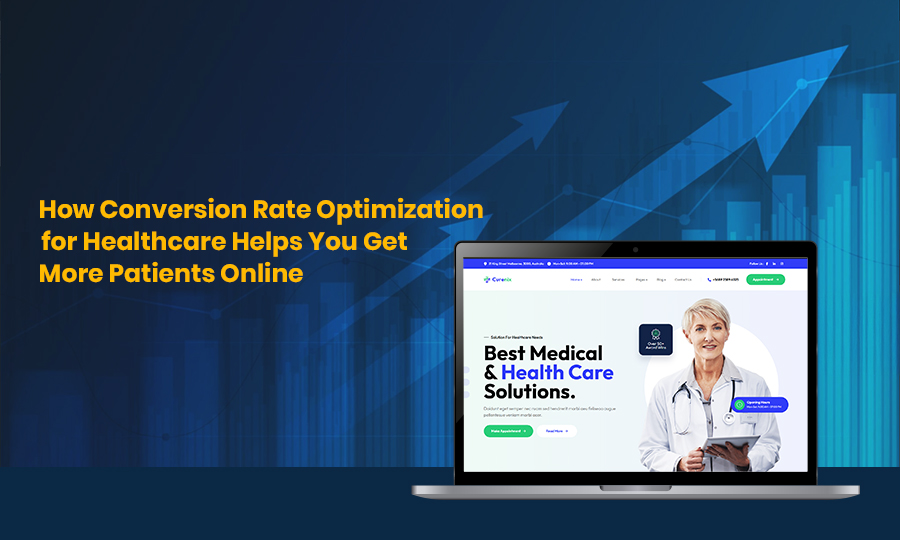
Nowadays, patients do not choose a healthcare provider solely based on convenience anymore. They research, compare, and scroll through the search engines and service pages before making a decision. Effective conversion rate optimisation for healthcare professionals allows them to stay ahead of the competition by successfully aligning their content, website, and CTA with advanced marketing tactics.
CRO can help healthcare practices to turn mere leads into loyal patients by encouraging them to schedule appointments with them while maintaining a stern focus on offering high-quality patient care.
Are you someone who is looking to enhance the brand awareness of your healthcare practice and get more patients online? Then this blog is for you.
It will discuss the importance of optimizing the conversion rate for healthcare, effective strategies to optimize the conversion rate for healthcare practices, major conversion rate optimization mistakes, and more. So, let’s get started.
Understanding Conversion Rate Optimisation for Healthcare Providers
Conversion Rate Optimization (CRO) for healthcare practices is the process of transforming website visitors into loyal patients. This means encouraging a website visitor to book, call, or sign up, basically encouraging them to take any desired action that will move them closer to becoming new patients.
This approach includes successfully evaluating patient behaviour, eliminating barriers to conversions, implementing modern strategies to overcome them, enhancing user experience, and transforming digital traffic into real-time patient growth and engagement.
How conversion rate optimization works in healthcare:
- Analyse User Behaviour: Incorporate heatmaps, analytics, and user feedback to determine how visitors are using the site and where they are leaving.
- Identify Barriers: Healthcare practices must figure out why visitors are not converting. For example, slow page loading speed, complex navigation, and a lack of trust signals.
- Make the Changes: Healthcare providers must make essential data-driven modifications to the website.
- Experiment: You can compare different versions of a page to determine which one is performing the best.
- Iterate: Constantly refine your healthcare site based on results.
Why Conversion Rate Optimization Matters for Healthcare Professionals
Now that you have a clear idea of what content rate optimization is and how it works, let us discuss why it is crucial for healthcare providers.
- Driving More Appointment Bookings
Conversion rate optimization for healthcare businesses simplifies complex online forms, making the scheduling process faster, shorter, and easier. The more efficient your healthcare website is, the lower the costs you have to bear in order to get new patients. Better conversion rates result in more patients, leading to increased revenue generation and opportunities for higher ad spend/traffic.
- Enhancing Patient Satisfaction
CRO strategies enhance the website usability, making it easier for patients to navigate between pages and easily acquire the information they are looking for. A secure, clear, and user-friendly website with easy navigation can make patients feel like sharing their personal health-related information. When patients feel valued online, they are likely to trust and engage with your healthcare practice.
- Boosting Revenue Through Better Engagement
Remember, engaged patients are loyal patients. Conversion rate optimization can help healthcare practices offer an exceptional online experience to their patients, fostering deep relationships, leading to repeated visits and referrals. Healthcare practices can implement resources like heatmaps to determine user behaviour and make targeted modifications.
- Supporting Telemedicine Growth
In the present day, telemedicine has become a crucial healthcare service. Conversion rate optimization helps healthcare practices ease the process of virtual consultation, guaranteeing that patients can easily access and schedule telehealth services.
Effective Strategies to Optimize Conversion Rate for Healthcare
With the world moving towards modernisation, traditional CRO strategies have fallen short in meeting the demands of both the healthcare providers and patients.
So, healthcare professionals must make sure to implement advanced conversion rate optimization strategies in order to achieve more conversions. In this section of the blog, we will discuss some effective CRO strategies that healthcare providers must implement.
- Focus on Mobile-First Design
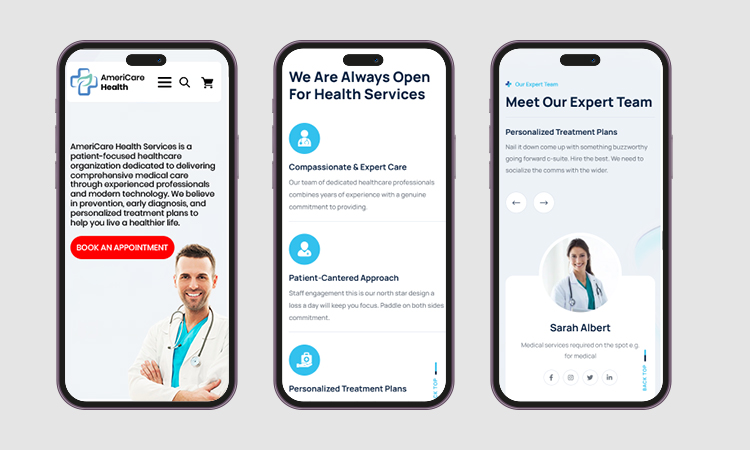
With the majority of web traffic coming from mobile devices (64.53%), developing a mobile-first website design has become more crucial than ever.
Nowadays, more and more people are using their smartphones to access information online, and neglecting mobile optimization can cost healthcare providers a significant amount of website traffic and conversions.
CRO prioritises responsive designs that offer easy navigation on all devices. So, healthcare practices must focus on leveraging a responsive design to offer a seamless user experience irrespective of what devices they are accessing from.
How to Develop a Mobile-friendly Website
To design a mobile-friendly website, healthcare professionals must follow the steps listed below:
- Responsive Design: This is the foundation. A responsive design is an excellent way to ensure that your website performs well on every device. Implementing a responsive design uses code that automatically adjusts your website to the size of the screen it is accessed on. This ensures that your website looks good on both desktop and mobile devices.
- Optimize Images: Image optimization is crucial when conducting conversion rate optimization for healthcare practices. Make sure your images are well-optimized for mobile devices. This means minimising the file size and using images that fit perfectly on every screen size on which they are viewed. Optimizing your website images can help increase page speed, leading to a better user experience.
- Keep the Design Simple: When developing a mobile website design, make sure to keep the design as simple as possible. Do not complicate it with too many menus and big chunks of content. Rather use a minimal amount of images and texts and ensure an easy navigation.
- Incorporate Clearly Visible Buttons: A great way to design a mobile-friendly website is to use large buttons that are clearly visible to your visitors. This will make it easier for mobile users to notice and tap on them. Clearly visible buttons are easier to click on mobile devices, so healthcare practices must make sure that their CTAs are prominent and easy to find.
- Optimize Page Speed: Healthcare practices must optimize their page speed by compressing images, leveraging HTML5, minimising redirects, and considering Accelerated Mobile Pages (AMP) to ensure a faster loading speed.
- Avoid Using Unnecessary Pop-ups: I mean, sometimes, pop-ups can be fun, but not when they appear abruptly, especially on smaller screens, as they entirely block out the content. Moreover, pop-ups can be more complex to close on mobile devices than on desktops, so it is better to avoid them altogether. If you still wish to use a pop-up, make sure it is easy to dismiss, even on smaller screens.
- Use Easy-to-read Fonts: Healthcare practices must leverage fonts that are easy to read on mobile devices. This means you must avoid small and complicated fonts and use large and readable fonts instead. Fonts that are easy to read will make your healthcare website more navigable and user-friendly.
- Leverage Short Forms: Most of the time, mobile users simply scroll and try to achieve the information as fast as possible. Healthcare practices must consider it and use short forms that are easy to fill out. Avoid creating forms that are too lengthy and complicated.
- Use GPS Directions: In case you have a physical location, you must include GPS directions on your mobile website. This will help the mobile traffic to easily locate and reach out to you.
- Develop an Engaging Call-to-Action
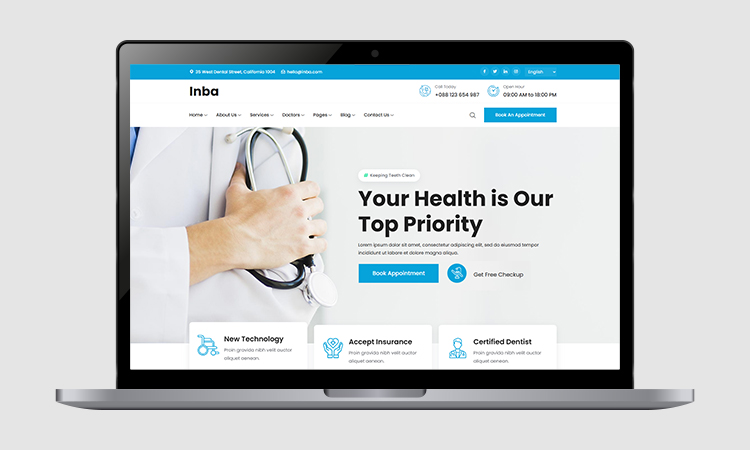
CTAs are one of the most crucial aspects of conversion rate optimization for healthcare practices. In fact, using a powerful, clear CTA can boost conversion rates by 161%. This statistic proves that CTAs are exceptional drivers of user engagement and conversions for healthcare professionals.
The right CTA can make all the difference by transforming mere leads into loyal patients by clearly informing them what they must do next in order to proceed.
However, vague CTAs won’t work at all. If you want your CTAs to be effective, you need to implement strong, action-oriented language to create a sense of urgency or highlight the benefits of taking up a particular service.
How to Write Compelling CTAs for your Healthcare Practice
Writing CTAs is quite a task, so healthcare practices must not take it lightly. Here are some CTA best practices that healthcare providers must know.
- Implement a Powerful Verb at the start of your CTA
Remember, you do not have enough space to convey your point in detail. So, rather than beating around the bush, healthcare practices must state their point directly. Let your audience know what exactly you want them to do by leading each of your CTA buttons with an action verb.
Healthcare practices can start their CTAs with powerful and captivating action words like “Register,” “Call now,” “Schedule,” or “Book.” For example, “Book a free consultation today!“
- Add Words that evoke Emotions
If you want more clicks and conversions, you need to bring out a strong response from your audience. An evoking and compelling CTA that utilises emotional copywriting is just the thing you need in this case.
Let’s say someone is looking for joint replacements, and they come across a CTA that goes like, “Unlock 20% Savings on Joint Surgery- Book Now!” They will get all hyped up and think about how good it will be to regain their mobility while not having to vacate their pockets, encouraging them to click on the button.
Healthcare professionals must make sure to maintain professionalism and use words that successfully connect with their patients’ feelings and emotions. CTAs like, “Don’t Let Joint Pain Get the Best of You- Schedule Your Joint Replacement Consultation Today!” can also be very effective in eliciting the emotions of patients.
- Give Them a Reason to Act
In simple words, healthcare providers need to tell potential patients what is in it for them if they click. What problems of your potential patients will it solve, or what value will they gain? Healthcare practices must emphasise outcomes like “feeling healthier” and “peace of mind.” For example, healthcare practices can write CTAs such as “Get Expert Advice on Pain Management.”
Through this CTA, you have clearly stated the action you wish the visitor to take, as well as provided them wth a proper reason why they must take the action.
- Align CTA to the Type of Device
Relevant CTAs matter a lot when performing conversion rate optimization for healthcare services. Healthcare providers must design their CTA in a way that it performs seamlessly across all types of devices, including desktop, laptop, and mobile devices. Writing an exceptional CTA is not enough; healthcare businesses must consider personalising their CTA based on the type of device from which they are being accessed.
On mobile phones, healthcare practices must use clearly visible, easy-to-tap buttons and ensure a positive click-through experience. It will be best to lead them with a “learn more,” “schedule now,” or “download now.”
- Do not forget to A/B test your CTA
A good, old-fashioned A/B test is an exceptional way to determine which CTAs are bringing clicks and which are not working effectively.
Healthcare professionals must regularly experiment with different versions of their CTAs to observe which ones perform the best. Experiment with various button colours, fonts, copy lengths, and placements to optimise your conversion rates.
CTA Elements that Healthcare Providers must Test:
- Button Copy: Make sure to test various action phrases and their lengths.
- Design: Test the colour, shape, size, and placement
- Surrounding Context: How is the supporting text affecting conversion
- Urgency Elements: Limited-time offers vs. evergreen messaging.
When testing, healthcare practices must not change all elements simultaneously; rather, they must change one element at a time to figure out what is affecting the performance. A lot of healthcare practices have noticed that personalised CTAs often outperform the generic ones.
- Include Numbers Wherever Possible
It cannot be denied that customers respond pretty positively to seeing numbers such as discounts, pricing, promotions, and incentives. This is because incorporating numbers can add value and clarity. Healthcare providers must highlight data points like the number of satisfied patients, years of expertise in healthcare, or quick service time to foster trust among potential patients.
The best example of this CTA is something like, “Schedule a Consultation in Under 24 Hours.” In case you are running a special offer, you can create a CTA like, “Book Today! 25% off your next visit.”
- Establish your Conversion Marketing Strategy
If you want to ensure a successful conversion rate optimization for healthcare professionals, you need an effective conversion marketing strategy.
While healthcare practices can implement simple conversion techniques with their existing tools, prompting social media followers and transforming more visitors into loyal patients requires a robust conversion marketing strategy.
Let’s see how healthcare practices can establish an effective conversion marketing strategy.
Offer Patient-Centric Digital Experience
- Optimize your Website: Healthcare practices must make sure their website is mobile-friendly, has a faster loading speed, and includes a clear and powerful Call-to-action (CTA). For example, “Book now.”
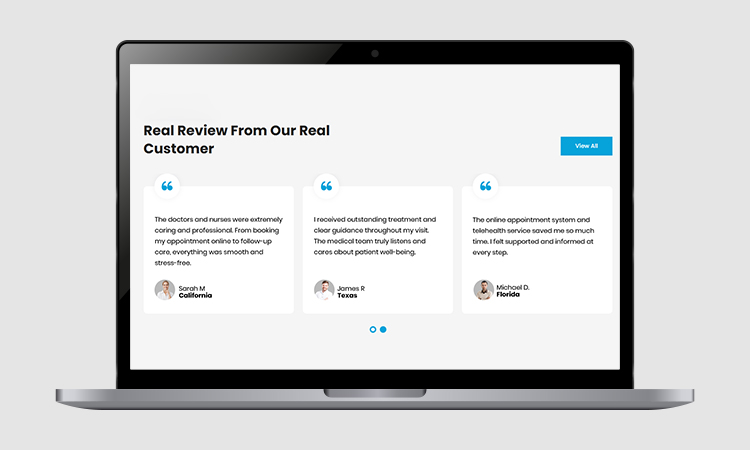
- Foster Trust: Make sure to showcase doctor bios, positive reviews, and patient testimonials prominently.
- Service-Specific Landing Pages: Healthcare practices must develop dedicated landing pages for major treatments to seamlessly guide users to relevant information, encouraging them to take action.
Attract and Retain:
- Content Marketing: Healthcare practices must share valuable health tips, blog posts, and FAQs to establish authority and clearly answer patient queries.
- Local SEO: Optimize for local search terms so that patients can easily find your practice when searching for healthcare services in your area.
- Video Marketing: Use videos of doctor introductions, patient stories, and procedure explanations.
Driving Actions:
- Leverage Clear CTAs: Healthcare practices must implement action-oriented language (e.g., “Schedule your Visit Today!”).
- Email or SMS Marketing: Nurture leads with tailored health information and appointment reminders.
- Paid Ads: Run targeted Google ads to captivate high-intent searchers.
Retain and Grow: Establishing Relationships
- Patient Portals and Two-Way Communication: Healthcare practices must make it easier for patients to connect and feel valued.
- Social Media Engagement: Implement quizzes, polls, and share valuable health content to build a community.
- Remarketing: Healthcare practices must retarget their past website visitors with ads to bring them back to their healthcare practice.
Measure and Comply:
- Track Key Metrics: Hospitals and clinics must monitor key metrics such as website traffic, conversion rates, and patient feedback to gain valuable insights.
- Guarantee Compliance: You must make sure to maintain strict compliance with healthcare regulations like HIPAA in all marketing activities.
- Simplify Patient Interaction with Chatbots
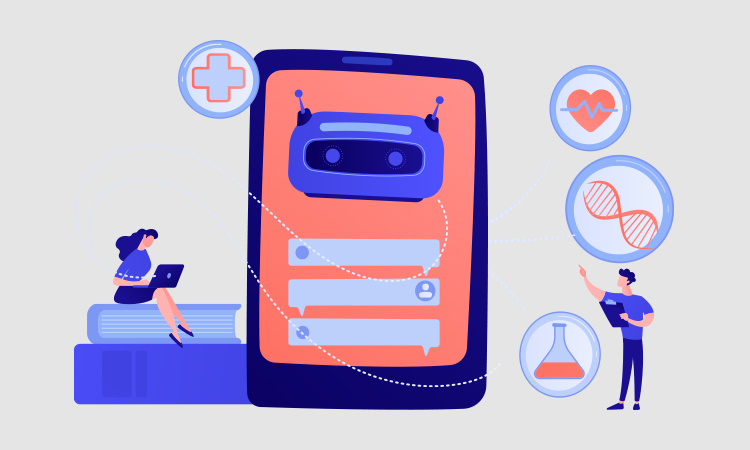
Chatbots are computer programs that simulate real-life, human conversations to offer instant information, offer support, and perform complicated and routine tasks easily. They act as digital assistants that healthcare practices can implement on their website, apps, and smart devices like Google Assistant and Alexa and play a major role in effective conversion rate optimization for healthcare providers.
With chatbots making patient communication easier nowadays, more and more healthcare practices must incorporate them. Interactive chatbots can answer common patient queries and guide patients to the right healthcare service they are looking for.
Here are a few ways healthcare practices can streamline patient interaction by implementing chatbots.
- Offer 24/7 Instant Accessibility: Chatbots often reduce frustrating waiting times and limited office hours, allowing prospective patients to gain instant answers and book appointments anytime, without any hassle. This immensely helps in capturing leads that might otherwise be lost while you are unavailable.
- Simplify Appointment Management: Automating the appointment scheduling, rescheduling, and cancellation process through a user-friendly chat interface can significantly minimise administrative burden and reduce the likelihood of missed appointments.
- Offer Guided Symptom Assessment: Chatbots can ask patients about their symptoms and leverage clinical algorithms to recommend the most appropriate treatment or how they should proceed, guaranteeing that patients are directed to the right level of care efficiently and fostering trust.
- Automate Administrative Tasks: By effectively handling routine queries about insurance verification, clinic hours, and billings, chatbots can help healthcare practices and their teams to focus on high-priority tasks, like offering high-quality patient care and enhancing overall operational efficiency.
- Tailored Patient Engagement: By leveraging natural language processing and machine learning, chatbots can offer personalized recommendations, send tailored medication reminders, and offer effective healthcare tips on the basis of a person’s past health records. This constant, tailored interaction establishes trust and encourages patients to engage more effectively in their health management.
- Robust Data Privacy and Compliance: Maintaining privacy is crucial for an effective conversion rate optimization for healthcare practices. Healthcare professionals have to deal with a lot of sensitive information. This makes compliance with regulations such as HIPAA mandatory. Establishing a secure and compliant system that uses proper encryption and obtains user consent is crucial for building patient trust.
- Test and Modify Your Conversion Marketing Efforts
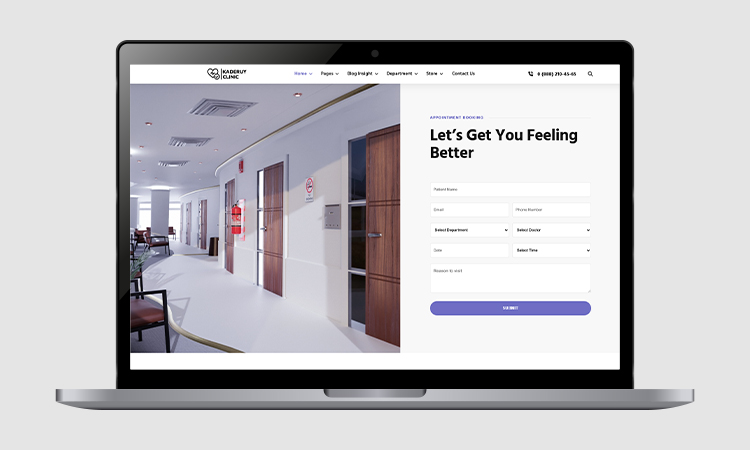
Constant testing is crucial to determine what encourages prospective patients to act. Some of the most commonly tested variables include:
- CTA Buttons: Test the colour, size, font, location, and wording of your CTA.
- Images: Healthcare practices must try photos vs. no photos, colourful vs. black and white images, single vs. multiple subjects.
- Copy: Make sure to test active vs. passive voice, conversational vs. technical diction, statement vs question.
- Landing Page Design: Healthcare practices must test the form length, page layout, visual hierarchy, and choices of images or videos to minimize frictions and avoid distractions.
- Mobile Optimization: Make sure your webpages load quickly and are easily navigable on mobile devices, with easy-to-tap buttons and simplified forms.
- Personalisation: Healthcare practices must deliver personalized content and offers based on demographics and user behaviour. For example, showcase different testimonials to new vs. returning visitors.
Process of Conversion Optimization
An organized approach guarantees that modifications are data-driven and not simply based on assumptions.
- Gather Data and Identify Barriers: Healthcare practices must implement analytics tools like Google Analytics and measurable feedback like heatmaps, session recordings, and user surveys to determine how visitors are engaging with your website. Identify where exactly in the conversion funnel visitors are leaving, as well as the reasons, objections, and pain points.
- Conduct A/B Tests Regularly: A/B testing is vital in order to compare an original version of an element with the modified version to see which one performs better.
- Isolate Variables: Healthcare practices must make sure to test only one element at a time in order to achieve clear results and avoid confusion.
- Guarantee Statistical Significance: Run tests for a specific time and with an adequate sample size in order to test the results.
- Note Down Everything: Keep a document of every test, results, and learnings to establish an internal knowledge base.
- Evaluate Results and Incorporate Winners: If a single variant outperforms the control, healthcare practices must incorporate it as the new baseline.
- Repeat the Process: Conversion optimization is a constant cycle of improvement, and not a one-time fix.
- Focus on Form Optimisation
Form optimization is one of the vital steps of conversion rate optimization for healthcare businesses. Forms are a gateway between a user’s interest and a visible conversion, whether it is a lead, subscription, or sale. Form optimization is the process of carefully designing and refining these forms to minimize user friction and increase conversion rate.
A poorly designed form is the biggest conversion killer. Form optimization includes strategically balancing minimizing fields, enhancing user experience, and applying psychological principles to guide users seamlessly to the submit button.
Helpful Tips for Effective Form Optimization:
Optimizing the forms of your healthcare website often requires a patient-centric approach. In these forms, every field should justify why it is included, and the overall process must feel intuitive and effortless for your website visitors.
- Ask Only for Crucial Information: Every additional field you are adding to your forms increases friction and cognitive load. So, healthcare practices must start by asking the most basic information in order to complete the initial conversion. You can always collect more information later by implementing techniques like “progressive profiling.”
- Leverage Single-Column Layout: For the majority of forms, especially on mobile devices, a single-column layout can be easier for visitors to follow. This is because single-column forms can create a very clear and straight path from the top to the bottom, preventing distractions around the page and minimizing confusion.
- Incorporate Real-Time Validation: Healthcare practices must offer instant feedback after a visitor has completed filling out the form. Leverage inline validation to showcase a green checkmark for every correctly filled field and a red error message in case the information is incorrect. This prevents visitors from getting frustrated when submitting a form, leading to a positive user experience.
- Clearly Mark Optional Fields: Rather than marketing every required field with an asterisk to showcase that they are necessary to fill out, healthcare practices must consider marking only a few optional fields. This will show that your form is shorter and less demanding, which can encourage them to complete filling out the form.
- Leverage Email Marketing to Encourage Leads and Increase Retention

Implementing mail marketing is crucial to ensure a successful conversion rate optimization for healthcare organizations. Do you know that email marketing produces an average of 174% more conversions than social media? This showcases the importance of email marketing to transform leads into loyal patients. Email marketing is a direct path to both prospective and existing patients. It allows healthcare practices to fortify their value, remind visitors to take actions, and establish long-term patient relationships that drive both repeated visits and new bookings.
How can Healthcare Practices Build a Strategic Email Marketing Campaign that Converts
The most effective email marketing campaigns are timely, personalized, and relevant, ultimately delivering value instead of noise. To get there, healthcare practices must start by establishing automated campaigns that are triggered by specific patient actions:
- Welcome Emails: Healthcare practices must make sure to send welcome emails as soon as a patient signs up for their newsletters or schedules their first appointment.
- Informative Campaigns: These campaigns clearly explain preparation steps before a surgery, treatment procedures, or post-care guidance tips.
- Promotional Campaigns: Campaigns that showcase seasonal services, case studies, new doctors, patient success stories, and testimonials.
- Follow-Up Emails: These emails are reminders for annual checkups, lab results, or missed appointments.
Role of Email Marketing in Driving Conversions
Email marketing is one of the most crucial digital marketing efforts and a great conversion driver. To date, email remains one of the most effective channels to drive conversions. Unlike paid ads and social media, email marketing offers access to your audience even without increasing costs and algorithm changes.
Building a complete list of email subscribers and interacting with them effectively can help nurture strong relationships, retrieve abandoned carts, and guide potential patients through your online marketing funnel.
Here are a few ways to enhance conversion rates with email marketing:
- Lead Nurturing and Generation: Healthcare organizations must capture emails by offering value (e.g., comprehensive guides) and leverage an automated sequence to guide leads towards buying.
- Customization and Segmentation: Make sure to offer highly relevant, exclusive deals and product recommendations based on user behaviour, enhancing the likelihood of interaction and conversion.
- Direct Communication: Foster trust and loyalty by staying top-of-the-mind with meaningful and regular updates. This will establish strong patient relationships.
- Behavioural Triggers: This is a crucial approach to ensure effective conversion rate optimization for healthcare businesses. Email marketing uses automation for timely messages like reminders for abandoned carts or welcome sequences, tapping into psychology to prompt action.
- Upselling and Cross-Selling: Email marketing can also help healthcare practices to promote additional services, enhancing customer lifetime value.
- Measurable ROI: Healthcare practices must offer measurable metrics (click-through rates, open rates) to refine strategies and ensure effectiveness.
- Incorporate Social Proofs and Trust Signals
Social proof is basically the psychological phenomenon where people often copy the actions of others to identify the right behaviour, especially when they are uncertain, assuming others have more knowledge.
In digital marketing, social proof means using reviews, testimonials, and trust signals to make prospective patients believe that they are making the right decision. When visitors see that others have taken up your service and had a positive experience with your healthcare practice, it significantly minimizes their anxiety and establishes instant authority.
This is the major driver of success for businesses across various sectors, especially in the healthcare sector. Integrating social proof is one of the most effective conversion practices, as it can help healthcare practices foster deep trust by showing that people have had a good experience with your practice.
Best Tips for Effective Social Proof
To foster trust among patients, healthcare practices must make sure their social proof is authentic, clearly visible, and relevant. Simply creating a testimonial page is just not enough; it needs to be filled with positive experiences from your past patients. So, here are some of the most effective social proof tips for healthcare businesses.
- Display your Reviews Clearly: Do not hide your reviews; showcase them. Incorporate star reviews and customer feedback directly on your product or your product and service pages, near the prices/plans, where they will make the most impact.
- Improve Testimonials: Healthcare practices must make their patient testimonials more authentic and personalized by adding the patient’s full name, along with a high-quality image, their location, and how your practice has helped them. Avoid adding vague reviews or testimonials from fake patients. Rather, politely ask happy patients to give a detailed testimonial, sharing their experience with your practice.
- Leverage User-Specific Trust Badges: Highlight your security seals like SSL certificates, any awards or recognitions, as well as payment provider logos such as Mastercard or Visa. These signals often guarantee website visitors that their confidential health information is safe with you and that your business is authorized.
6 Biggest Conversion Killers that Healthcare Providers Must Watch Out For
Conversion rate optimization for healthcare practices is quite a complicated process, and not everyone understands it. In order to avoid common conversion rate optimization mistakes, medical practices must be familiar with them.
So, here are some of the major conversion challenges that healthcare providers must avoid.
- Slow Website Loading Time
Let’s face it, no one wants a slow-loading website. Do you know that even a 100-millisecond delay in website loading time can harm conversion rates by 7%? So, healthcare practices must focus on developing a fast-loading website in order to avoid frustrating their patients. Websites that are too cluttered and take a long time to load are likely to lose a significant amount of website visitors, leading to higher bounce rates.
Patients who expect the same level of digital inconvenience that they are experiencing from other healthcare practices will be quickly frustrated by friction points such as complex layouts, unnoticeable buttons, and broken internal search functions.
How can healthcare practices resolve it?
- In order to ensure a fast-loading website, healthcare practices may optimize their website images by compressing and resizing them.
- Healthcare practices must also minify their CSS and JavaScript codes.
- Make sure to enable browser caching as well as minimize unnecessary redirects.
- Healthcare practitioners can use tools such as PageSpeed Insights to determine and fix website performance issues.
- Lack of Mobile Optimization
The majority of patients access the Internet through mobile devices to search for healthcare providers and schedule appointments. A non-responsive site with complex navigation, difficult layouts, and small buttons can lead to a negative user experience, driving prospective patients away.
Healthcare providers must make sure that their website is well-optimized and functions well even on smaller screens. Your content should be clearly readable, your conversion process must be easy, and your website must feel trustworthy and relevant.
How can healthcare practices resolve it?
- Healthcare practices must leverage a responsive design that easily adapts to all screen sizes.
- Make sure all the clickable buttons on your website are clearly visible and easy to tap.
- Healthcare practices must simplify their navigation menus so that mobile users can easily navigate their website.
- You must leverage click-to-call functionality for phone numbers.
- Absence of Clear Call-to-Action
Without a clear and engaging CTA button, visitors will feel lost and unsure of the desired next step, especially on mobile devices. Absence of a prominent CTA can negatively affect the conversion rate optimization for healthcare providers. According to stats, optimizing CTAs for mobile devices can boost conversion rates by 32.5%.
Every crucial webpage on your healthcare website, from your homepage to doctor bios, should have a personalized and clear CTA. Rather than burying your CTAs between large chunks of text or blending into the background, healthcare practices must make sure their CTAs are clear enough and easily readable for every website visitor.
Healthcare practices must leverage contrasting colours and bold texts to write CTA copies such as “Schedule your appointment today!” to help them stand out.
How can healthcare practices resolve it?
- Leverage powerful, action-oriented words for your CTA buttons.
- Healthcare practices must make their CTAs visually appealing and prominent using contrasting colours.
- Make sure to position them in a position where they are easily noticeable by website visitors.
- Healthcare practices can place them in high-engagement areas, like the top corner of the navigation menu, or right next to crucial information.
- Poor User Experience
If your website has a complex navigation, it might frustrate your visitors, making them exit your website and choose your competitors over you. Complex forms, disturbing pop-ups, and confusing layouts heavily contribute to a poor user experience.
The majority of users are always busy, and they just scroll away when they cannot find the information they are looking for easily. So, healthcare practices must make sure all their forms are designed to be simple, are easy to read, and their websites do not have a confusing layout.
How can healthcare practices resolve it?
- Healthcare practices must make sure to design a website with clear navigation and a logical layout.
- Make sure to keep your forms simple by only asking for essential information and allowing guest conversion.
- You must perform thorough user testing to determine any usability issues and make data-driven modifications.
- Healthcare businesses must also focus on organizing their service pages clearly so that it is easier for visitors to find the information they are looking for.
- Lack of Trust Signals
A major mistake in conversion rate optimization for healthcare professionals is that they overlook trust signals or elements, which are crucial, especially in the healthcare industry, as they are directly related to a person’s health.
When it comes to their health, patients want the best. So, they are extra cautious when choosing a healthcare provider for their practice. The absence of trust signals can make visitors hesitant to share personal information or schedule appointments.
How can healthcare practices resolve it?
- Prominently display your trust signals, such as security badges (e.g., HIPAA compliance badges), certifications, and secure payment methods.
- Use genuine patient testimonials, case studies, and reviews to establish credibility.
- Make sure all your privacy policies are clear, well-written, and easily accessible.
- Low-Quality and Generic Content
We all might have heard the saying, “Content is the king,” right? This is because your content is the primary way to keep your website visitors engaged for a longer period.
If your healthcare content is generic, full of jargon, and does not focus on resolving the queries of patients, then it is a problem. This makes it very difficult to build expertise and showcase how the provider resolves a specific problem.
How can healthcare practices resolve it?
- Healthcare practices must create high-quality, patient-focused content that directly addresses the common health-related concerns of patients using easy-to-read fonts and language.
- Emphasize the benefits patients will receive through your services, rather than simply listing your products and services.
- Healthcare practices must make sure that their content is optimized with relevant keywords in order to attract the right audience.
How can a Professional Digital Marketing Agency Help Healthcare Professionals with Conversion Rate Optimization
To ace the conversion rate optimization game, you need the proper knowledge. However, not everyone is good at everything. As a healthcare practitioner, you may be familiar with the technicalities of healthcare, but not with the technicalities of the conversion rate optimization process.
What you can do in this case is let the experts handle it. So, here are a few reasons why healthcare practices must hire a digital marketing agency to successfully optimize their conversion rate.
- Can Help Achieve More from your Marketing Budget
Nobody would want their budget to go down the drain just like that. By carefully implementing effective strategies for conversion rate optimization for healthcare providers, a digital marketing expert can help multi-location healthcare practices to gain better conversion rates and improve ad spend, helping healthcare practices to keep those earned dollars right in their pockets where they belong.
- Engage Patients with Patient-Centric Creative
Place your patients at the very middle of your CRO strategy. A well-experienced digital marketing agency can help healthcare practices engage patients with personalized and targeted messaging and creative. These targeted messages are designed in a way that they directly address their major pain points, attracting high-quality leads to your healthcare website as well as enhancing conversion rates.
- Uses Thorough Data-Driven Testing
Data is what guides your CRO strategy. A good healthcare digital marketing agency can help get into the depths and perform extensive, in-depth audits in order to create an effective conversion rate optimization strategy and testing roadmap. They strictly focus on repeated improvements and outcomes to improve the user experience, ultimately boosting conversion rates.
- Help Improve Patient Journey at Every Step
A digital marketing expert can make it easy for potential patients to navigate your healthcare website and eliminate unnecessary steps to conversion. This is literally a win-win situation for both the healthcare practice and its patients. This is because the healthcare practice gets higher conversion rates; on the other hand, patients can seamlessly access the information they are looking for.
FAQs
Ans. Healthcare Conversion rate optimization is vital because it turns website visitors into loyal patients by establishing trust, enhancing user experience, and boosting marketing ROI, leading to higher revenue and patient acquisition.
Ans. Maximizing the conversion rate of your orthopaedic clinic offers various significant benefits, including better marketing efficiency, more revenue and profits, and increased patient loyalty.
Ans. The 6 crucial elements of conversion rate optimization include a user-friendly website design, engaging content, clear CTAs, trust signals, A/B Testing, and well-optimized forms.
Ans. The best CRO tools for analysis cover various needs like analytics (Google Analytics), user behaviour (Hotjar), A/B testing (Optimizely), and feedback (Typeform).
Conclusion
Successful conversion rate optimisation for healthcare practices is vital, as it transforms a healthcare provider’s website from a confusing maze to a clear and seamless path, enhancing patient acquisition, boosting revenue even without draining your pockets, and establishing trust with transparent information and privacy. By clearly understanding the patient journey, maintaining consistency in testing and refining your approach based on your analytics, and writing clear CTAs, healthcare practices can turn leads into loyal patients. Start by incorporating the above-mentioned conversion rate optimisation strategies, and in case you are still confused about what to do, we recommend that you partner with a professional digital marketing agency.

